-
1. Write the installation requirements before opening a catalog
-
2. Read the datasheet like a contract, not a menu
-
3. For flood light private label, know what is actually changing
-
4. A catalog revision date is not a lifecycle promise
-
5. What to look for in a wall light supplier
-
6. Ask what the supplier will not do for you
-
Final checks before you sign the order
Before joining Schreder lighting, I spent nine years buying outdoor lighting for a regional distributor. Today, I sit on the Schreder outdoor lighting specification desk, where I see the same ordering mistakes from the other side. I have personally made, and documented, eight substantial mistakes. Together they cost roughly $52,000 in scrapped stock, rushed re-makes, and apologetic shipping labels. This checklist is what I use now before approving a flood light private label project, reviewing a sports lighting catalog, or evaluating a wall light supplier.
Who this is for: wholesalers, distributors, OEM buyers, and project managers who need outdoor lighting for street, sports, wall, flood, and area light applications. If you are choosing between product ranges before you have a project requirement list, this checklist is the fix.
Six steps. No marketing language. If a supplier cannot survive these checks, the product will annoy you after installation.
1. Write the installation requirements before opening a catalog
Do not start with how many lumens. If you do, you will end up comparing fixtures that are mathematically similar and physically different. The non-negotiables are: environment, mounting geometry, light control, compliance, and control system. In a coastal area, a wall light with a good BUG rating but a poor salt-spray finish will fail within a few years. For a flood light private label order, you need beam distribution details and aiming requirements. For sports lighting, you need glare and spill control limits. If the requirement is not typed out, you will discover it after delivery.
It is tempting to think you can compare unit prices at this stage. But identical wattage and identical lumen numbers can produce wildly different results once the fixture is mounted, aimed, and measured.
2. Read the datasheet like a contract, not a menu
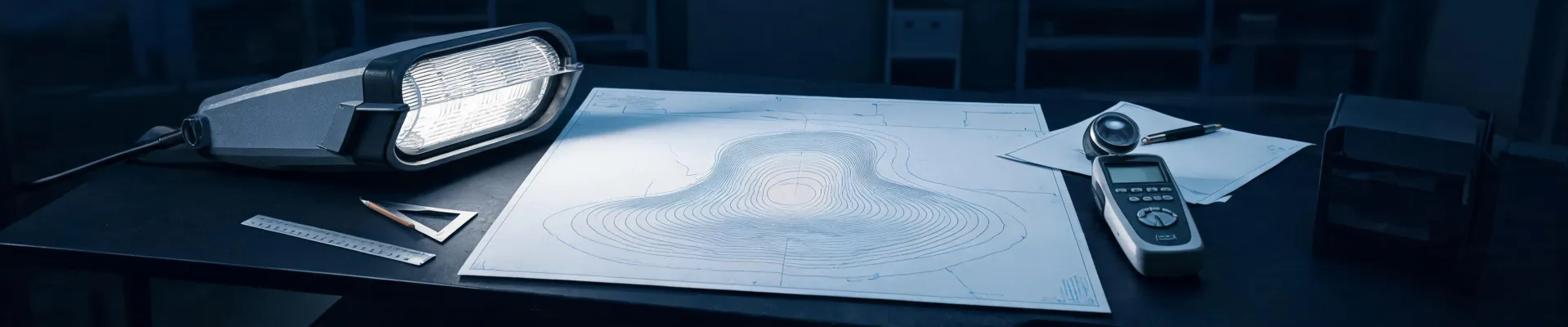
When someone hands me a sports lighting catalog, I do not start by checking the fixture photos. I ask for three things: the photometric file for each intended model, the datasheet for the exact order code, and the LM-79/LM-80/TM-21 test reports. A catalog is a list of possibilities. Without those three files, it is not a technical document.
IES LM-79 documents luminaire electrical and photometric performance. IES LM-80 documents LED package or module lumen maintenance. IES TM-21 projects long-term lumen maintenance. If a datasheet references none of them, the warranty comparison is meaningless.
Why does this matter? Because permits, energy code submittals, and field acceptance often depend on these reports. For a sports lighting catalog, also ask for aiming diagrams, vertical illuminance calculations, glare ratings, and spill light data. For a flood light, ask for beam angles at the exact driver settings you plan to buy. Do not accept an upstream LED lumen value as if it were the fixture output.
3. For flood light private label, know what is actually changing
Private label sounds simple, but it is not just a logo. Before you order a flood light private label package, get a line-item answer to these questions:
- Is the brand change a sticker, or is the fixture housing and electrical label manufactured with your brand?
- Who is listed as the legal manufacturer on the label? Who holds the safety listing or certification?
- If the CCT, driver, or optic changes, does the supplier provide a new photometric report and updated compliance documentation?
- Who owns the tooling, drawings, and approved vendor list? Can changes be made without your written approval?
- Which markings appear on the carton, the product, and the installation instructions?
In September 2022, I approved a flood light private label order without checking the marking plate under the logo. The sample looked fine in the office. When the carton arrived, the electrical label still carried another manufacturer name. We had to relabel 70 cartons and resubmit documents. That mistake cost about $1,900 and added a four-day delay.
Looking back, I should have asked for a photograph of the actual marking before approval. At the time, the logo sample was good enough. That was the wrong level of detail.
4. A catalog revision date is not a lifecycle promise
The latest edition of a sports lighting catalog tells you when it was printed. It does not tell you which products are still supported, which drivers are still available, or which housing revisions are current. Ask the supplier: which models are active, which are being discontinued, and what replacements match the existing mounting layouts? Ask what happens if an optical component changes after your order arrives.
In Q1 2024, I reviewed a quote where the catalog drawing showed a different driver cover than the actual housing. It was a small difference, but it meant the catalog had not been updated after a component change. That is the exact moment an incorrect product number gets into a specification.
5. What to look for in a wall light supplier
Wall lights are the easiest outdoor lighting category to oversimplify. They are not just smaller flood lights. They mount close to facades, under eaves, on parapets, and above doorways where reflected light, mounting orientation, and glare behave differently.
What to look for in a wall light supplier can mostly be covered by asking for documents and being suspicious of one-word answers. I look for these specifics:
- Photometric file for the wall-mounted orientation, not just a generic vertical fixture file.
- BUG rating for backlight, uplight, and glare, especially if the area has dark sky or residential light limits.
- Mechanical drawing showing the bracket, mounting bolt pattern, and required junction box compatibility.
- Driver options that match your control system, including 0-10V dimming, photocontrol, or sensor integration.
- Corrosion test data for coastal or industrial environments, not just the word marine-grade.
If the supplier can answer those questions with actual test reports, you have a credible source. If the answer is no worries, you do not have a spec. You have a hope.
6. Ask what the supplier will not do for you
One of the strongest signs of a good outdoor lighting partner is a supplier who will tell you where their product is not the right fit. I trust the vendor who says, this application is outside our strength, and here is who does it better. That answer earns trust for every other order.
The outdoor lighting companies I trust are the ones who do not claim that every fixture, every pole, every control system, and every project is equally within their expertise. A broad product range is useful. Pretending every application is the same is not.
At Schreder, our outdoor lighting range covers street lighting, sports lighting, wall lights, flood lights, and area lights. But the phrase I want our team to use when needed is: this is outside the intended application of this product line. That boundary is a form of respect.
Final checks before you sign the order
I cannot tell you which supplier is best for your project. I can tell you the mistakes I keep seeing:
- Approving a sample based on CCT and wattage only, while ignoring optics, driver current, and operating temperature.
- Assuming initial lumen output is the same as maintained lumen output. Check TM-21 and the driver vendor documentation.
- Choosing a wall light supplier without knowing the BUG rating or wall-mount photometric behavior.
- Signing a private label agreement without confirming the legal manufacturer on the product label.
- Using a sports lighting catalog as a product lifecycle document instead of asking about component change notifications.
The old advice to always get three quotes ignores the real cost of evaluating the wrong vendors. I am not saying use one supplier. I am saying define the requirements, demand the data, and ask where the limits are. If you do that, the quote review process gets faster and the installation gets quieter.

Clara Whitmore is a lighting photometry and LED source analyst specializing in bulbs, tubes, strips, panels, and integrated luminaires. She interprets IES LM-79 measurements and TM-30 color rendition data through luminous flux, efficacy, intensity distribution, CCT, chromaticity, fidelity, and gamut metrics. She writes evidence-led comparisons for specifiers selecting source formats and luminaires for commercial interiors, industrial spaces, or horticultural systems where measured optical and color performance matter.