Thursday, 7:14 p.m. I almost let the call go to voicemail.
I work in distributor support at Schreder outdoor lighting. Calls after 7 p.m. usually mean one of three things: a shipment is stuck, a spec just got rejected, or someone else's missed deadline is about to become my emergency.
This one was the third.
'How fast can you really ship flood lights?' Marcus asked. No hello.
Marcus runs a small distribution company outside Tulsa. Two employees, one warehouse bay, and a reputation with local contractors that matters more than any online review. He had won the lighting package for a new regional sports complex: two soccer fields, a parking lot, and a grand opening locked in for March 21, 2026. All together, the project needed 46 flood lights and area lights.
At some manufacturing plants, 46 units barely registers. For Marcus, it was the difference between becoming the go-to distributor for phases two and three or getting labeled as the one who couldn't deliver.
He had ordered the fixtures from an online flood light supplier whose price was almost too good to pass up. The 14-day lead time seemed like a bonus. By the second week of February, the order was 26 days late, the supplier could not say when the drivers would arrive, and the phrase 'shipping container' was used a few too many times. The general contractor had given Marcus until February 20 to prove the fixtures were on the road. Otherwise, he was pulling the electrical scope, applying the penalty clause, and sourcing the lights himself.
What the Original Supplier Couldn't Prove
I didn't begin with a product pitch. I asked Marcus to send over the original fixture schedule, the pole layout, and every photometric file the other supplier had shared. He forwarded the files from his truck at 8:05 p.m.
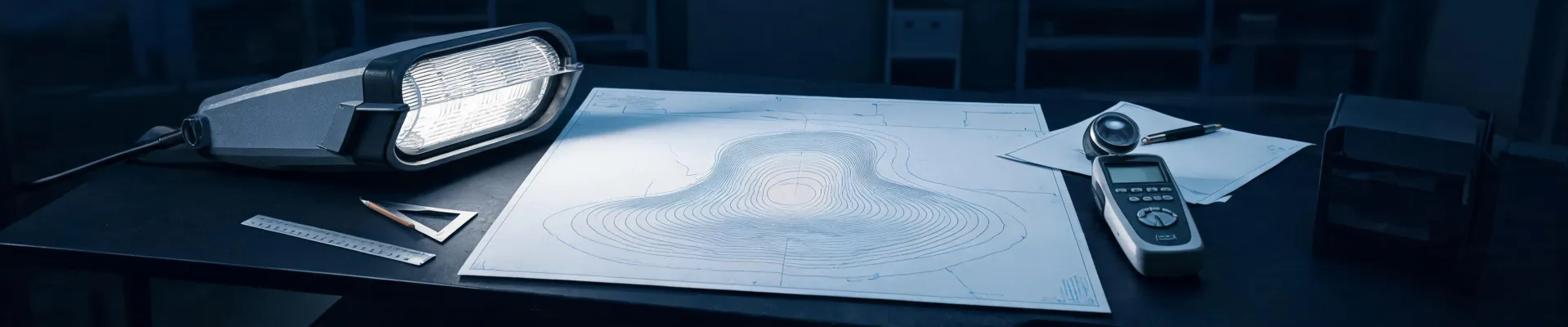
Take a guess what wasn't in the folder. There was no LM-79 photometric test report for the exact model numbers he ordered. The IES file that came with the quote was labeled for a completely different fixture in the same 'series.' It described a 220W Type III area light. Marcus had ordered a 150W Type II.
Small difference? In lighting, optics are the product. The housing is just a box for the electronics. If the manufacturer doesn't know what their Type II optics actually do because they never tested them, they are absolutely not going to fix a glare complaint from a neighbor's backyard two months after installation.
There was also a utility rebate issue. The town required fixtures that were listed in the DLC database under the exact model number. Marcus's quote said 'DLC listed.' The database didn't have that model. It had a cousin with a different part number.
None of these problems were hidden. They were all discoverable before payment. They just weren't discovered. I don't say that to be unkind to Marcus. He was doing what a busy owner does: trusting a cheap quote and praying.
A Friday Afternoon Proposal
That Friday morning, two of our application engineers and I reviewed his site layout. The design originally called for 5000K fixtures. The complex sits near a residential area, and the town's lighting code restricts uplight. We could match the illuminance targets with 4000K optics, reduce spill at the property line, and give his customer a more comfortable nighttime environment. None of this was exotic work. It is the kind of homework that should have been done in January.
By 4:30 p.m., Marcus had a written proposal: 40 fixtures ready to ship the following Friday, with 6 units following a week later. Along with the quote, he got IES files for the exact optics, DLC listing numbers for the exact models, and a delivery schedule that included a buffer day for freight.
Marcus had two hours to lock it in. Production slots don't wait while a buyer thinks. I normally advise customers to sleep on a decision and get a second opinion. There was no time for that, and I hated asking him to decide that way.
He said yes at 6:12 p.m. I hung up, and for the next 24 hours I kept second-guessing. What if the drivers didn't clear inspection? What if I had promised a schedule that one late afternoon could break? I didn't relax until I saw the first pallet photo come through from our loading dock.
The Week That Nearly Fell Apart
The following Wednesday, our freight partner couldn't confirm pickup. Not because anything was wrong with the fixtures; the shipment had been ready since Tuesday. The truck simply hadn't shown up. I told Marcus what I knew and no more, because I didn't have a better answer yet.
On Thursday morning, a truck finally backed into the dock. We loaded 40 fixtures, photographed every pallet, and sent the photos to Marcus's phone. Then the truck sat for 26 hours at a transfer hub in Missouri. Just sat. The driver was waiting on a trailer that hadn't arrived.
So glad we built that buffer day into the schedule. We almost cut it out to save a few hundred dollars on freight. That decision saved us.
The 40 fixtures arrived in Oklahoma the following week. The remaining six arrived five days later, as promised. Installation started on schedule, the city inspector signed off on the flood lights and area lights with no rework, and the grand opening kicked off with all 46 fixtures running.
Marcus texted me a photo from the parking lot at about 9:30 that night. No caption. Just a wide shot of the complex lit up and empty. I knew what it meant.
What I'd Check Before You Need a Rescue
I don't have hard data on how many last-minute lighting orders happen because someone skipped a photometric check. But after working on more than 200 urgent project requests since 2023, I can tell you the pattern is usually the same.
Here's the checklist I wish Marcus had been given back in January. It only takes an afternoon, and it filters out most of the bad flood light suppliers.
- Ask for the LM-79 report for the exact model. IES files are easy to copy. A real photometric test report is tied to a specific product and a specific set of optics. If the supplier sends one file for a whole family, treat that as a red flag.
- Confirm the DLC listing by exact part number. The model family does not count. Type the part number into the DLC database before you write a PO.
- Define lead time in units, not promises. Don't ask 'do you have stock?' Ask how many complete fixtures they can put on a truck today and which components are physically in hand. Good manufacturers can answer that in one email.
- Ask about spare drivers and warranty service. A ten-year warranty isn't useful if replacement parts arrive in six weeks. Ask whether spare drivers ship with the order or are stocked locally.
- Test how they treat a small order. Send a small RFQ and watch what happens. If the response is slow or dismissive, you just learned how they will treat you after the sale.
When a flood light supplier can't produce photometric data for the exact model you ordered, they're selling hope, not luminaires.
Small Orders Aren't a Waste of Anyone's Time
Marcus's order was 46 fixtures. It will never be the biggest file in our factory, and I'm not going to pretend it was. But the response had nothing to do with the number of units.
Here's why I care: small orders reveal how a supplier really works. I've watched manufacturers treat a 40-piece order like a distraction, only to chase the same customer when a larger project appears. The suppliers that stay consistent, for big and small orders alike, are the ones that still matter to their customers years later.
Small doesn't mean unimportant. It means potential. Most large distribution relationships I can think of started with a test order that looked a lot like this one.
Schreder outdoor lighting works with distributors, contractors, and OEM/private label buyers. We don't claim to be the cheapest option, and we won't pretend to be right for every project. What we do best is give straight answers: real photometric files, real compliance numbers, and honest timelines. If your next project doesn't fit neatly into a national account template, that's okay. Those are the calls I answer after 7 p.m.

Clara Whitmore is a lighting photometry and LED source analyst specializing in bulbs, tubes, strips, panels, and integrated luminaires. She interprets IES LM-79 measurements and TM-30 color rendition data through luminous flux, efficacy, intensity distribution, CCT, chromaticity, fidelity, and gamut metrics. She writes evidence-led comparisons for specifiers selecting source formats and luminaires for commercial interiors, industrial spaces, or horticultural systems where measured optical and color performance matter.