Private label can wait. The spec can’t. If you’re sourcing outdoor lighting and the first thing you ask a flood light supplier is “Can we put our name on it?”, you’re asking in the wrong order.
I work in project support at Schreder lighting. That means I’m usually called when an order needs to move fast — or when a project needs to be saved before its deadline collapses. Over the past six years, I’ve helped coordinate 80+ rush requests for distributors, wholesalers, and contractors who needed Schreder outdoor lighting faster than standard production allowed. Very few of those calls were caused by factory delays. Most were caused by information that should have been confirmed before the purchase order went out.
From the outside, street lighting OEM vs private label looks like the big strategic question. The reality is more boring. The fixture doesn’t care whose name is on the housing. It still has to put the light in the right place, communicate with the controls on site, survive the environment, and satisfy the inspector who already has a date on their calendar.
So let me state my position clearly: choose the technical specification before you choose the branding arrangement. OEM versus private label is a real decision, but it should happen downstream of the spec.
What a rush order actually tells you
In March 2024, a rush request hit my desk at 4:15 pm. The client needed 46 flood lights for a sports facility by the following Tuesday. Their usual supplier had quoted four weeks. We could make the date if every detail stayed clean: 4000K, IP66, 277V input. The photometric report looked fine. Then I asked, “What does the control system expect?”
Silence.
The site had a central DALI lighting control system, but the quote had been built around the standard photocell option because nobody wrote the dimming protocol into the spec. The fixture would have worked perfectly as a standalone unit and completely failed as part of the installed system. We caught the gap before production, changed the driver option, and shipped in time. The fix cost extra engineering time, a different driver, and a later truck. Five minutes of verification earlier would have saved all of it.
Five minutes of verification beats five days of correction.
Photometry and compliance are not branding decisions
One dangerous oversimplification in outdoor lighting is, “It’s the same wattage and the same lumen count, so it’s the same fixture.” For outdoor luminaires, that statement is almost never true.
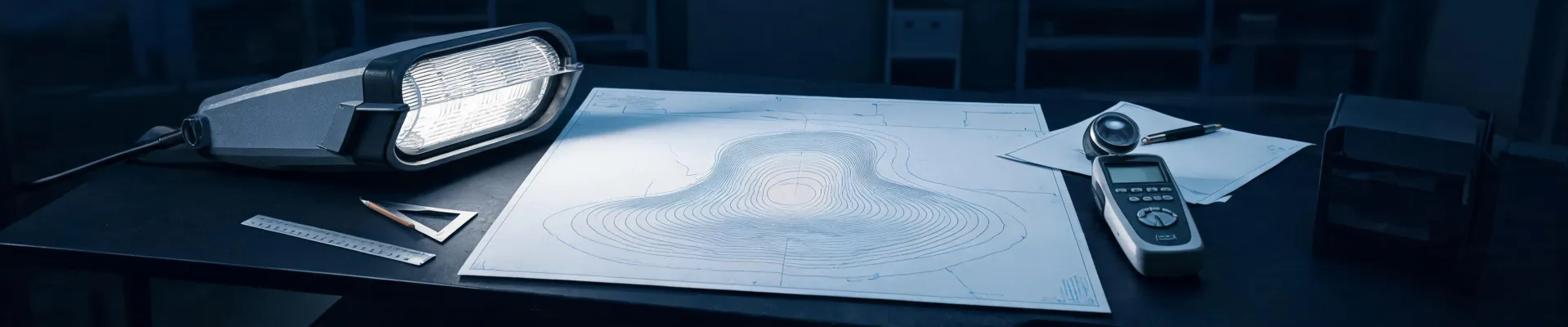
I made this mistake in my first year. I compared two flood lights and approved a substitute because the wattage, color temperature, and IP rating matched. What I didn’t compare was the beam distribution. The same LED package can be combined with different optics to produce a narrow road distribution, a wide parking-lot distribution, or a tight accent beam. When the fixture was installed, the beam pattern was clearly wrong for the pole layout. We replaced the optic, but the project schedule already had a dent.
Compliance works the same way. A luminaire can be certified as a base product, but the installed configuration — controls, surge protection, wiring, mounting — has to match what the certificate covers. When you add a private label, you are responsible for that linkage. If something fails, the customer doesn’t call the factory. They call you.
So where does OEM vs private label fit?
OEM and private label are not magic categories. OEM is a manufacturing relationship: the factory builds to your specification. Private label is a branding relationship: your name goes on the final product. In practice, they overlap. But neither one removes the need to verify the photometric, electrical, and compliance data.
Outdoor lighting private label is especially tempting because it feels like a clean way to differentiate your product line. But it’s really a transfer of responsibility. That doesn’t mean you shouldn’t do it; it means you should be even harder about the technical review, not softer.
Street lighting OEM vs private label decisions often show up at the end of a municipal bid, when time is short. That’s the worst time to introduce a new branding variant. If the city expects a tested product with a named supplier, a private-label version should have been qualified months before the bid, not after.
A broad catalog isn’t an answer
The Schreder lighting catalog is broad. Street lighting, sports lighting, wall lights, flood lights, area lights — when a project changes at the last minute, that range is useful. But I always warn distributors that a broad product range gives you options, not conclusions. The conclusion comes from the site requirements, the pole layout, the controls, and the local compliance rules.
That’s also how I’d evaluate a flood light supplier. Look for someone who asks about control compatibility, pole mounting, voltage, and compliance evidence before they ask about your logo. If the conversation jumps straight to “we can private label it”, you should hear an alarm.
Here’s the checklist I want every private-label project to have on page one:
- Voltage, frequency, and wiring class.
- Control input and dimming protocol.
- Photometric distribution, not just total lumens.
- IP rating and mechanical impact rating.
- Certificates that match the project location and configuration.
- Mounting option: pole top, side entry, wall bracket, or trunnion.
If a cell is empty, leave a question mark. A question mark is honest. It tells everybody what still needs to be confirmed before the logo gets printed.
But wait: my customers expect my brand
I’m not saying branding is vanity. Branding can be the difference between a one-time transaction and a long-term relationship. If you’re a distributor, private label is a legitimate way to build loyalty. I understand that.
What I’m against is the order of priorities. If the customer’s brand is the first decision, the spec becomes second. Then the project becomes urgent. Then the logo you wanted is on a product that doesn’t do what the layout says it should do. Your customer won’t call the manufacturing plant. They’ll call you.
So if you’re going to put your name on a luminaire, own the verification process even harder. If you don’t have time to own it, don’t private label that project. Standard product with clean compliance paperwork will always move faster than a branded variant introduced at the last minute.
My final point
I don’t think emergency orders will ever disappear. There will always be project changes, late design updates, and impossible site conditions. But a lot of emergency orders are avoidable. They come from disagreements between specs, controls, and deadlines. You don’t fix those by moving faster at the end. You fix them by doing the slow, annoying verification work before the logo is printed.
So if you’re still comparing street lighting OEM vs private label options, ask yourself what you’re actually solving. If the answer is a branding strategy, do that after the luminaire is correct. If the answer is “we need a supplier who asks the right questions”, that’s the conversation worth having now.
Choose the spec first. Choose the brand after.

Clara Whitmore is a lighting photometry and LED source analyst specializing in bulbs, tubes, strips, panels, and integrated luminaires. She interprets IES LM-79 measurements and TM-30 color rendition data through luminous flux, efficacy, intensity distribution, CCT, chromaticity, fidelity, and gamut metrics. She writes evidence-led comparisons for specifiers selecting source formats and luminaires for commercial interiors, industrial spaces, or horticultural systems where measured optical and color performance matter.