-
Questions I get asked most
-
What should I check first when evaluating a flood light supplier?
-
Is Schreder outdoor lighting worth a spot in a wholesale lineup?
-
How do I compare wall light wholesale offers without getting tricked?
-
Which specifications really matter for outdoor lighting wholesale?
-
Does OEM/private label support matter when choosing Schreder?
-
What warranty traps should a wholesale buyer look for?
-
When should I NOT choose Schreder lighting?
I started buying outdoor lighting for wholesale in 2019. Correction: I started at a regional distributor in 2017, but I took over the outdoor lighting category two years later. Since then, I've approved 140+ purchase orders and tracked every dollar in our cost system. Some orders were no-brainers. Others taught me lessons the expensive way.
This FAQ is for people on the buying side — distributors, wholesalers and private-label buyers — who want to know how to choose outdoor lighting for wholesale without repeating my mistakes.
Questions I get asked most
- What should I check first when evaluating a flood light supplier?
- Is Schreder outdoor lighting worth a spot in a wholesale lineup?
- How do I compare wall light wholesale offers without getting tricked?
- Which specifications really matter for outdoor lighting wholesale?
- Does OEM/private label support matter when choosing Schreder?
- What warranty traps should a wholesale buyer look for?
- When should I NOT choose Schreder lighting?
What should I check first when evaluating a flood light supplier?
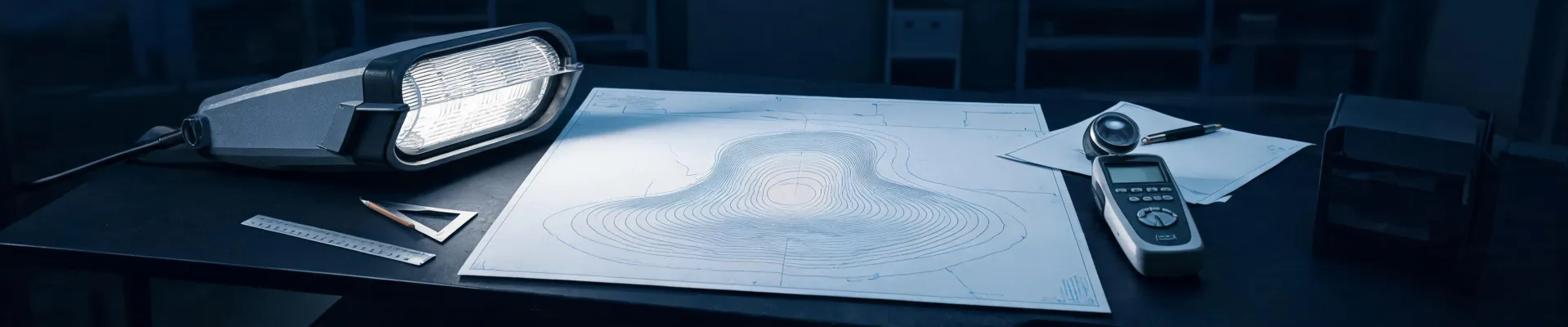
Photometry.
Not wattage. Not the lumen number on a spec sheet. If a flood light supplier can't email an IES file the same day you ask for it, that tells you something.
I've compared two flood lights that looked almost identical on paper — similar wattage, similar lumen output. In a parking lot layout, one met the target with eight fixtures. The other needed eleven. The eleven-fixture option was cheaper per unit. By the time we added poles, labor and cable, cheap wasn't cheap anymore.
From the outside, photometry looks like a technical detail. From a P&L, it's a price increase.
One more thing: driver brand. If a quote says 'LED driver' instead of naming a manufacturer and model, treat it as an unspecified component. We accepted an 'equivalent' driver substitution in 2022 to keep a delivery on schedule. It worked, but the dimming curve didn't match our customer's control system. Not ideal. Workable. Still cost us two site visits to sort out.
Is Schreder outdoor lighting worth a spot in a wholesale lineup?
Whenever someone asks me this, I check our own order history before answering. Our first Schreder order was placed in Q3 2022. As of early 2026, I can tell you what the purchasing records show — not what a brochure promises.
Three things keep Schreder lighting in our range. First, consistent photometric data: when we download an IES file for a Schreder outdoor lighting product, it matches the product we receive. That sounds basic, but it is not universal. Second, explicit component specs: the quotations name the driver, the surge protection and the housing materials. No supplier's choice clauses. Third, engineering support: we receive calculation files, installation drawings and photometric layouts without fighting for them. That saves my team hours per project.
Real talk: Schreder will not win a low-bid RFQ. If your customer purchases strictly on first cost, you can find cheaper fixtures and probably should. But when I run the numbers over a ten-year ownership period, Schreder outdoor lighting tends to come out ahead — fewer returns, fewer claim disputes, less time spent verifying data.
Our return rate on Schreder units is the lowest in our outdoor category, based on our ERP data. I should note that our sample is mostly street and area luminaires, not their entire catalogue.
How do I compare wall light wholesale offers without getting tricked?
Get every vendor to quote the same scope. That sounds obvious, but it's where most comparisons fall apart.
During a 2024 wall light RFQ, one bid arrived at $23.50 per unit. Another was $27.80 per unit. The higher quote included the mounting bracket, a photocell and a named driver. The cheaper one required an extra $7.60 in accessories and left the driver unspecified. Once we aligned the two scopes, the 'cheap' quote became $31.10 per unit — about 12% above the supposedly expensive one.
The line items I compare on every wall light wholesale quote:
- Mounting bracket and backplate
- Photocell or daylight sensor
- Driver brand and model
- Surge protection
- Packaging and labeling
- Freight terms and Incoterms
A quote without these details isn't a lower price. It's an unfinished quote. When a supplier hides the missing pieces behind a low unit price, that's a red flag.
Which specifications really matter for outdoor lighting wholesale?
I'm not a lighting designer, so I won't pretend to judge which beam shape looks better in an architectural rendering. What I can do, as a buyer, is insist on the same core information from every supplier before we talk price.
The checklist I use: IES or LDT photometric files for each optic option, a named driver manufacturer and model, surge protection rating, IP and IK ratings, operating temperature range, and regional certifications such as UL, CE or CCC depending on your market.
People assume identical-looking fixtures from different factories will perform the same. They don't. Two wall lights can have the same shape and lumen output, but different thermal design, driver quality and gasket material. Those differences show up in the declared specs before they show up in the field.
One caution: certification lists change. A product that was UL-listed last year may have an updated status in 2026. Verify before you put it in your catalog.
Does OEM/private label support matter when choosing Schreder?
It matters if you're planning to sell under your own brand. Schreder offers OEM and private label programs for distributors with enough volume, and that support can be valuable: custom labeling, packaging, documentation and compliance guidance are handled at the factory level rather than by your own in-house team. But private label is not something you request casually.
We looked at a private label arrangement in 2023. At our then-volume of about 400 units per product family per year, it didn't make sense. If I remember correctly, the volumes needed to justify the program were meaningfully higher — though don't quote me on the exact threshold, because the conversation was several years ago and terms evolve.
If you have stable, forecastable demand, private label lets you build a distinctive catalog without maintaining a second engineering department. If you don't have that volume, you're usually better off carrying Schreder under its own name. The brand recognition does part of the selling for you.
What warranty traps should a wholesale buyer look for?
Every manufacturer says 'five-year warranty' or 'ten-year warranty'. The words are less comparable than they look.
I compare warranty terms line by line: what exactly is covered, whether that is the LED engine, driver, surge protector, or the complete fixture; who diagnoses the failure and who approves the claim; who pays freight in each direction; and whether the resolution is a repair, replacement, or credit. Those details change the value of a warranty more than the number of years does.
In 2023, we had 34 wall lights with surge-damaged drivers after a severe storm. One supplier asked for photos and serial numbers, then shipped replacement drivers within a week.
Another supplier required the entire fixture to be returned, freight prepaid, and then repaired rather than replaced. The process took five weeks and tied up our replacement stock. The failure was identical. The warranty process was not.
From our records, Schreder's claims process has been straightforward — we submit the order number, serial numbers and failure details, and get a clear answer. But I'd still get the current policy in writing before signing anything. Teams and terms change.
When should I NOT choose Schreder lighting?
I'm not going to tell you Schreder is right for every distributor. It isn't. No single outdoor lighting manufacturer is right for every order, and a first-rate product in the wrong segment just adds cost.
Here's the test I use:
- If your customer buys strictly on the lowest first price and nobody reviews photometric performance, skip the premium brand. A commodity-grade fixture can win that game on price.
- If you're sourcing a one-off replacement for an existing installation and the only goal is to match dimensions and wattage, you don't need an engineering-heavy supplier.
- If your market won't pay for better documentation, lower return rates or faster technical support, those advantages won't show up on your income statement.
That's roughly the 20% of cases where Schreder — or any well-engineered outdoor lighting range — is the wrong call. For the other 80%, where your customers will live with the lighting, pay its energy bill and measure its performance for years, the total-cost math usually points in the other direction.

Clara Whitmore is a lighting photometry and LED source analyst specializing in bulbs, tubes, strips, panels, and integrated luminaires. She interprets IES LM-79 measurements and TM-30 color rendition data through luminous flux, efficacy, intensity distribution, CCT, chromaticity, fidelity, and gamut metrics. She writes evidence-led comparisons for specifiers selecting source formats and luminaires for commercial interiors, industrial spaces, or horticultural systems where measured optical and color performance matter.