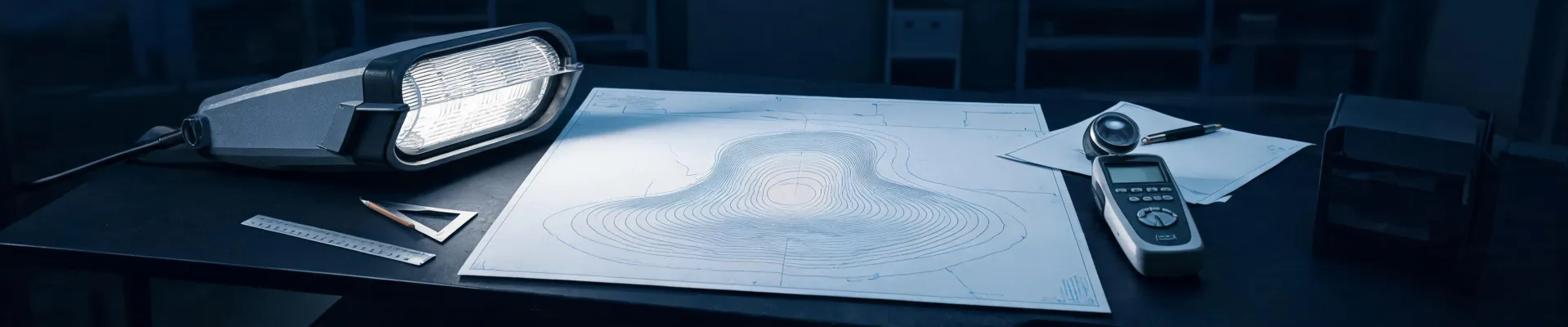
The Order That Changed How I Buy Outdoor Lighting
Last year, I placed what looked like a clean order: 40 street lights, confirmed lead time, the most competitive quote on my desk. "Easy win," I told my operations director.
Three weeks later, the site electrician rejected half of them. Wrong mounting adaptor for our pole type. The spec sheet didn't list it. The distributor didn't flag it. And I didn't ask.
That was the moment I stopped treating bulk outdoor lighting as a commodity purchase. Since then, I've spent a lot of time figuring out why this category trips up administrative buyers like me—and what separates suppliers who help from suppliers who just take the order.
You're Not Buying What You Think You're Buying
If you've managed purchasing for more than a year, you know the pattern. Compare quotes, check specs, confirm lead time, place order. That works fine for office supplies or furniture. It does not work for outdoor lighting.
Here's why: outdoor lighting specifications communicate intent, not guarantee. Two suppliers can both list "4000K, IP65, 1200lm" and deliver products that perform completely differently on-site. Same numbers on the page. Different outcomes in the field.
"I assumed 'same specifications' meant identical results across vendors. Didn't verify. Turned out each had slightly different interpretations."
That assumption cost me weeks of back-and-forth and a damaged relationship with my ops team. I learned it the hard way. You don't have to.
The Real Problem: Outdoor Lighting Specification Is Not as Standardized as It Looks
This is where most buyers—especially administrative buyers who manage many categories at once—get blindsided. Outdoor lighting uses a specification language that looks standardized but isn't. Here's what that actually means in practice.
Wall Light Specifications Are the Hidden Trap
Wall lights are often the smallest line item and the biggest source of problems. Wall light specifications involve lumen output, beam angle, mounting height compatibility, upward light ratio (ULOR), impact rating (IK), and IP classification. Get one variable wrong and the fixture looks off—or worse, fails inspection. IP65 tested under what conditions? Beam angle measured at what mounting height? These details almost never appear in a standard quote.
A vendor who hands you a datasheet without asking about mounting height or application is a red flag. Full stop.
Street Lighting Has Its Own Definitions
Street lights come with what look like familiar variables: watts, lumens, CCT, IP rating. But light distribution curves, glare control, and adaptor compatibility with existing poles and control systems matter far more in practice. I bought 40 street lights thinking the spec sheet covered everything. It didn't cover the mounting adaptor. That detail wasn't in the datasheet—it was "assumed" to be standard until it wasn't.
For anyone building a street lighting distributor buying guide, this is the single most important lesson: ask about adaptors, control compatibility, and warranty terms in writing. Don't let your distributor assume what "standard" means.
Certification and Documentation: The Quiet Deal-Breaker
Here's the part that doesn't show up in the sales brochure. Every outdoor lighting project may require compliance documentation: IEC 60529 for IP ratings, EN 60598 for luminaire safety, LM-79 and LM-80 reports for performance claims, RoHS declarations for materials, and country-specific certifications for export. When a project involves government tenders, public infrastructure, or cross-border delivery, missing documentation can kill the deal.
I dodged a close call once when I caught a supplier submitting a single test report covering two different fixture models. Nearly one click away from accepting it on a government project. If that had gone through, it wouldn't have been a "return and refund" situation—it would have been a compliance investigation.
What It Really Costs When You Get It Wrong
The financial cost is the first thing people mention and the least important part. Let me break down what actually happens.
Layer One: Money and Time
Returns mean new logistics, new production scheduling, new installation windows. A two-week delay on a street lighting order delays the whole project timeline. And here's the part nobody puts on the spreadsheet: chasing the replacement costs the buyer 10–15 hours of coordination. Multiply that by two or three incidents a year across categories, and the "cost savings" from choosing the cheapest vendor evaporates.
Layer Two: Your Internal Reputation
Administrative and facilities buyers are service coordinators. When something you ordered fails, it's not just a logistics problem—it's an operational problem for the people who trusted you to get it right. When your operations director has to explain to leadership why installations are delayed, you feel it. Your credibility becomes collateral.
It's a slow-burn issue. One mistake is survivable. But a pattern of "it happened again," and your team stops backing you on vendor decisions.
Layer Three: Compliance and Reputation Risk
If a project touches public sector buyers, export markets, or large property management firms, non-compliant documentation isn't a project problem—it's a liability problem. Incomplete certification data can void warranties, trigger audit failures, and in export cases, stall shipments at customs. That kind of damage isn't fixable by switching vendors.
What Actually Works (And What I Look For Now)
Bottom line: outdoor lighting isn't a commodity. It's a technical category with a commodity-style buying process that gets people into trouble. If you want fewer surprises, change the questions you ask, not just the vendors you contact.
These days I only work with suppliers who do three things:
- Walk through the specification line by line and explain what each term means for my specific application, not a generic one.
- Flag what they're not the best fit for. If a supplier says "for this application, we're not the best choice—here's who handles it better," they've earned my trust on everything else.
- Provide compliance documentation upfront, per-model, dated and verifiable—not a generic PDF with combined test data.
Schreder is a useful example of why this matters. Their outdoor lighting range covers street lighting, sports lighting, wall lights, flood lights, and area lights—technical categories that don't always play well together. What makes them worth keeping on a shortlist isn't just the range, it's that their technical team engages with the spec conversation at a granular level. For OEM and private label buyers, that engagement matters more than a 5% unit price spread.
There's something satisfying about finally getting the vendor process systematized: no more 3 a.m. worry sessions about whether the next shipment matches the spec sheet. Just quiet confidence that the supplier already checked the variables you would have missed.
If you're sourcing bulk outdoor lighting, don't start with the quote. Start with the specification conversation. Force suppliers to engage with the details. The ones who can answer—and who tell you where their boundary is—are the ones worth keeping.

Adrian Flores is an architectural and decorative lighting analyst specializing in pendant lights, chandeliers, wall lights, floor lamps, table lamps, and track lighting. He applies IEC 60598-1 luminaire requirements and photometric data to examine beam angle, shielding, surface temperature, mounting geometry, dimming compatibility, and glare. He writes practical guides for designers and buyers balancing visual character with usable illumination, safe installation, maintenance access, and total project cost.