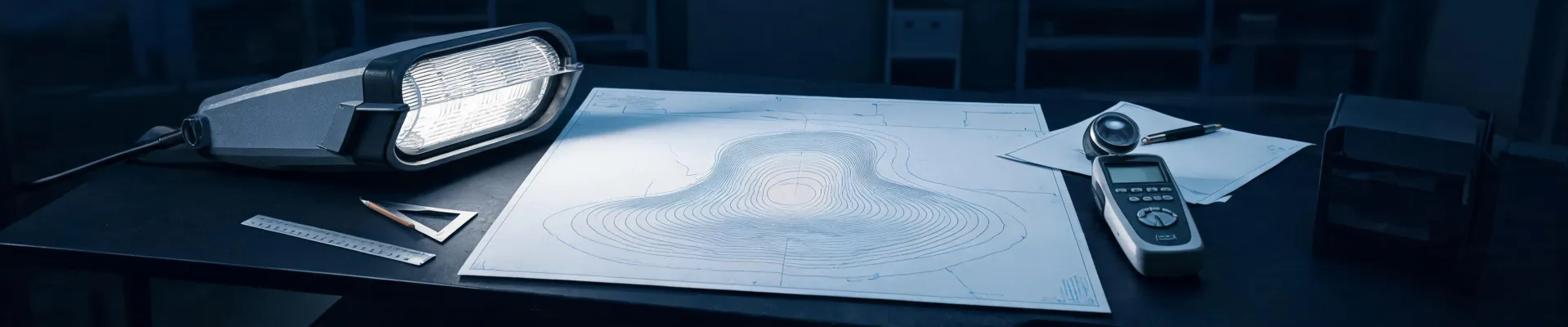
I still remember the pallet. It was a Tuesday morning in March 2023, and we'd just received the first shipment of what would eventually be a 3,000-unit bulk outdoor lighting order—2,000 flood lights, 800 wall lights, and 200 area lights split across two vendors. One of those vendors was Schreder. The other wasn't. The Schreder pallet looked fine. The other one didn't.
I'm the quality and brand compliance manager at a lighting distribution company. I review every batch before it goes to our channel partners—roughly 200 SKUs a year, sometimes more when the season picks up. In 2023, I rejected about 12% of first deliveries. Most of that was fixable. Some of it wasn't. This one turned into a six-week headache that reshaped how we write our purchase orders.
The Order That Started It All
We'd won a contract to supply a municipal park upgrade—pathway lighting, a few sports court flood lights, and a mix of decorative wall lights. The client specified LED flood lights in the 150W–200W range with a specific beam angle for glare control. Nothing exotic. This is bread-and-butter bulk outdoor lighting work.
We split the order because no single supplier had the full range at the volume we needed by the deadline. That's normal in this business. You learn quickly that "one-stop shop" almost never means "one delivery."
When I opened the first carton from the non-Schreder vendor, something felt off before I even turned the fixture on. The housing finish was slightly glossier than the approved sample. Small thing, right? The kind of thing you might shrug off if you're not paying attention. But the label inside said 4000K, and honestly, the light output when I hooked it up to our test rig looked closer to 5000K.
I pulled the datasheet. Then the PO. Then the approved sample, which we keep bagged and labeled in a locked cabinet for exactly this reason.
Spec mismatch. On paper it was 150W, 5000K, 120° beam. The delivered units were labeled 150W, 4000K, and the beam measured closer to 90°. That last part mattered—the client had specifically requested the wider spread to reduce hot spots on the walkways.
"It's within industry standard," the vendor told me on the call. "The CCT tolerance is ±300K, and beam angles vary based on the lens manufacturer."
I've heard this line maybe forty times in four years. It's almost always a red flag.
The Spec That Wasn't Actually a Spec
Here's what I learned the hard way: "150W, 4000K, 120°" on a purchase order is not a specification. It's a wish.
A real flood light specification includes:
- Luminaire efficacy (lm/W), not just wattage—two 150W fixtures can differ by 30% in delivered lumens
- Beam angle with a tolerance (e.g., ±5° of the nominal figure)
- Color consistency stated in SDCM (3-step MacAdam is what I ask for on municipal work)
- IP rating with the testing standard named—IP66 per IEC 60529, not just "IP66"
- Driver brand and model family, or an approved equivalent list
- Surge protection rating (kV), which matters more than most buyers realize for outdoor installs
- Operating temperature range, and whether that's ambient or case temperature
When we compared the Schreder units side by side with the other vendor's batch, the gap wasn't in the marketing claims—it was in the paperwork. The Schreder delivery came with a test report per batch: CCT measured, beam angle verified, efficacy stated with a measurement date. The other vendor sent a generic datasheet.
That's not a slam on anyone. It's just what a bulk outdoor lighting spec should look like when you specify it properly. The problem wasn't the vendor. It was our PO.
What We Did About It
We rejected about 1,400 units. The vendor offered a partial credit. We pushed back, and to their credit, they redid the batch and re-shipped at their cost. Total delay: 19 days. We ate overtime on the install to hit the municipal deadline—roughly $14,000 in extra labor. Not catastrophic, but not free either.
The Schreder portion of the order went through without a single rejection. Not because Schreder is magic, but because they ship with a batch-specific test summary by default—at least for the SKUs we ordered. If you're sourcing across vendors, this matters more than any single spec.
After that, I rewrote our standard PO template. It's now three pages instead of one. Every flood light line item carries:
- Nominal spec and tolerance
- Reference to the testing standard (IEC 60598, ANSI C136.31 for vibration if it's a pole-mount)
- A requirement for batch-level test documentation
- A clause that says spec misses outside tolerance constitute grounds for rejection at vendor's cost
Nothing exotic. Just explicit.
The Cost Conversation Nobody Handles Well
When distributors ask me about flood light wholesale cost, I usually push back on the question before answering it. "Cheapest per unit" and "cheapest per delivered, working, accepted fixture" are two different numbers, and the gap between them can be 15–25%.
Take the rejected batch. Unit price looked great—about 8% below our next best quote. But once we factored in the delay, the rework coordination, the client-side damage control, and the fact that we had to expedite the install, the real landed cost was higher than the Schreder option we'd initially passed on.
That's not an argument for always buying premium. It's an argument for pricing the specifications, not the fixture.
If you're building a flood light wholesale cost guide for your own org, I'd suggest benchmarking three tiers separately:
- Fixture cost
- Compliance and documentation cost (test reports, cert management, batch verification)
- Failure cost (rejection, delay, re-ship, client trust)
Most buyers only track the first. That's why the second and third numbers keep surprising them.
What I'd Tell a First-Time Bulk Buyer
I'm not an electrical engineer. I can't speak to driver topology or thermal modeling—that's a conversation for a lighting designer or a certified specifier. What I can tell you from a quality management seat is what to ask for, and what to do when the answer is vague.
Ask for batch test documentation before the PO is signed. Not a catalog. A real report with measurement dates.
Ask what happens if CCT drifts outside tolerance. If the answer is "it won't," that's not an answer.
And here's the honest limitation: this approach works well if you're sourcing 500+ units per SKU and you have a QA process. If you're ordering 40 fixtures for a single site and you don't have a test bench, most of this is overkill. In that case, buy from a distributor who already does this work and will show you their incoming inspection records. That's a different kind of value, and honestly, sometimes the smarter one.
Where I Landed
The park opened on time. The client never knew about the rework. Six months later, one of the Schreder flood lights in our test inventory—the same batch, still on the shelf—went out for a routine evaluation and hit every published spec within 2%. I remember standing in the test room thinking: this is what the paperwork is for.
There's something satisfying about a batch that just works. After the 19-day scramble, the awkward vendor calls, and the internal post-mortem where I had to explain why our PO template was too thin—seeing a fixture do exactly what the datasheet said it would do felt like a small win. It was.
Bulk outdoor lighting sourcing isn't about finding the cheapest or the best. It's about knowing which specs you're actually buying, and having the paper trail to hold everyone to it. That's the whole job.

Clara Whitmore is a lighting photometry and LED source analyst specializing in bulbs, tubes, strips, panels, and integrated luminaires. She interprets IES LM-79 measurements and TM-30 color rendition data through luminous flux, efficacy, intensity distribution, CCT, chromaticity, fidelity, and gamut metrics. She writes evidence-led comparisons for specifiers selecting source formats and luminaires for commercial interiors, industrial spaces, or horticultural systems where measured optical and color performance matter.