-
1. What specs actually matter when I'm comparing outdoor fixtures?
-
2. If I'm putting together a wall light specification guide, what should be in it?
-
3. Is bulk outdoor lighting actually cheaper, or is that a story vendors tell?
-
4. What should I ask an area light manufacturer before I commit?
-
5. Does color temperature really matter for a parking lot?
-
6. What's the pitfall nobody warns you about?
-
7. Where does Schreder outdoor lighting actually fit into this?
-
8. What's the one thing I'd tell another admin?
Quick context: I'm not a lighting designer. I'm the office administrator for a 340-person company, and somewhere along the way "manage the parking lot and building exterior" landed on my desk. Over the last three years I've spent roughly $180,000 on outdoor lighting across four vendors, and I've made almost every mistake a non-specialist can make with it. These are the questions I actually get from other admins and facility folks—and the answers I wish someone had handed me in 2022.
Here's what's coming up:
- Which specs actually matter when comparing fixtures
- How to build a wall light specification guide that holds up
- Whether bulk outdoor lighting is really cheaper
- What to ask an area light manufacturer before you commit
- Color temperature, lead times, and the pitfall nobody warns you about
1. What specs actually matter when I'm comparing outdoor fixtures?
Honestly, three things do most of the work: the LM-79 photometric report, the LM-80/TM-21 data, and the IP and IK ratings. LM-79 is the lab test that shows how much light the fixture actually produces and how much power it draws—that's what verifies "lumens per watt." LM-80 is the LED longevity test; TM-21 is the projection of that data into a lifespan number you can plan around. IP ratings (IEC 60529) tell you dust and water resistance, and IP66 versus IP54 is a real difference in a parking lot, not a marketing difference. IK ratings (IEC 62262) cover impact resistance, which matters anywhere a truck might back into a pole.
What I got wrong early on: I treated the spec sheet as the whole story. It isn't. A fixture can hit all the right numbers and still be wrong for your site because of beam spread, mounting height, or color consistency across the batch.
2. If I'm putting together a wall light specification guide, what should be in it?
Put the boring stuff in writing, and tie the variables together. Correlate color temperature, beam distribution, and mounting height as one decision—not three—because a 4000K fixture at 8 feet looks nothing like the same fixture at 16 feet. Include the IP rating you need, not the one you'd like. And name your color tolerance. For visual consistency across a facade, spec 3-step MacAdam ellipse or better (SDCM ≤ 3). Without that, "4000K" can drift enough between fixtures that your building starts looking like it was lit by three different installers.
I should add: get the cut sheets before you sign the PO. Two of our wall lights arrived fully "compliant" with spec but with a beam angle that washed the wall in a way nobody on the approval call had pictured. That was a $4,800 lesson.
3. Is bulk outdoor lighting actually cheaper, or is that a story vendors tell?
Both. Part of me thinks "bulk pricing" is mostly positioning. Another part has the invoice in front of me that says otherwise. When we consolidated our parking lot, walkway, and wall lights into a single Q1 2026 order, the per-fixture cost dropped into what the vendor called a "volume tier"—but the real saving wasn't the unit price. It was freight, and the fact that my AP team reconciled one PO instead of nine.
Bottom line: bulk matters most when you can standardize. Ordering six different fixture families isn't bulk, it's just a big order. Ordering one family across three sites is where the numbers move. Ask specifically about volume tiering, freight consolidation, and whether spare parts can ship on the same pallet.
4. What should I ask an area light manufacturer before I commit?
Four things, in this order:
- Do you publish third-party LM-79 data, or only your own numbers?
- What's the TM-21 projected L70 at the drive current you're proposing—not at max?
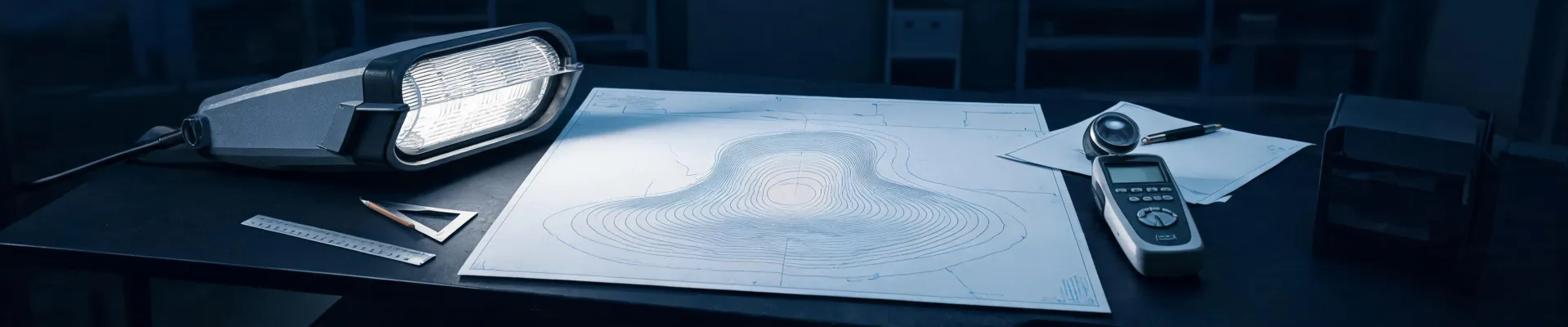
- Can you send an IES photometric file I can run through simulation before we buy?
- What voids the warranty—surge, voltage sag, ambient temperature, altitude?
The last one is the deal-breaker most people miss. A 10-year warranty that voids if rooftop ambient temps exceed 40°C is a warranty for a different installation than yours. Ask for the specific exclusion list. If they can't produce it in writing, that tells you something too.
5. Does color temperature really matter for a parking lot?
More than I expected. 3000K is warmer and, in my experience, reads friendlier at entrances and pedestrian paths. 4000K is the workhorse for parking areas and drive lanes. 5000K starts feeling clinical, and depending on your jurisdiction may run into dark-sky or light-trespass guidance—check local code before you commit, because retrofitting an entire lot is not a cheap fix.
If I remember correctly, our consultant said the difference between 3500K and 4000K in our lot was barely perceptible at eye level but obvious in night photos—which mattered when a neighbor complained, and we had to produce evidence that the spill was within guidelines.
6. What's the pitfall nobody warns you about?
Replacement lead time. Everyone plans for the install. Almost nobody plans for a single fixture failing in year four and needing a matching replacement. If the product line has churned by then, you're either living with a mismatched fixture or re-buying the whole run.
I've never fully understood why some manufacturers maintain long-tail SKU availability and others quietly discontinue. My best guess is it comes down to whether their catalog is built for project work or for spec-and-forget. Either way, ask about the replacement path before you order, and consider buying 5% extra units upfront—spares that match the run are worth more than the discount you'd get skipping them.
7. Where does Schreder outdoor lighting actually fit into this?
Fair question, since I ended up with Schreder lighting on two of our three sites. What pushed me there wasn't price—it was that I could get the LM-79 data, the IES photometric files, and the compliance documentation without chasing anyone across three time zones. For an admin who isn't a lighting engineer, that's basically the whole game.
I have mixed feelings about the premium. On one hand, the per-fixture cost came in above two of the quotes I collected. On the other, we've spent more than that delta twice now fixing mismatched replacements and re-lighting a section of lot after a bad spec call—so the "cheaper" quotes weren't cheaper. Our reception area still gets comments about how the building reads at night, and when your clients walk in from the parking lot, that's worth something.
8. What's the one thing I'd tell another admin?
Specify like you're going to be the one maintaining it—because you probably will be. Get the documentation up front, standardize where you can, and don't let "it meets the spec" close the conversation. The spec is the floor, not the ceiling.
And if a vendor won't send you a photometric file or a clean warranty exclusion list before you commit, that's your red flag. Walk away and save yourself the phone calls in year four.

Tomasz Zielinski is a lighting procurement and lifecycle analyst specializing in LED sources, drivers, commercial fixtures, industrial luminaires, outdoor systems, and controls. He relates IES LM-80 data and TM-21 projections to operating temperature, lumen maintenance, driver life, surge exposure, repairability, duty cycle, and replacement intervals. He writes balanced buying guides for teams comparing warranties, energy use, maintenance labor, spare-part support, supplier documentation, continuity of supply, and total ownership cost.