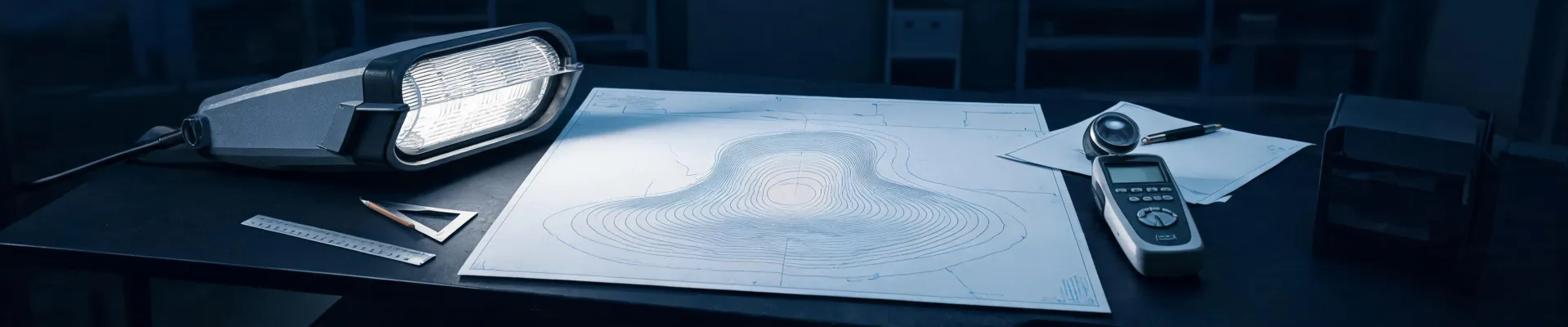
In February 2024, I approved a purchase order for 240 area lights. The unit price was $138. The next-lowest quote was $156. I saved $4,320 before lunch. Then I spent the next six weeks fixing it.
I handle outdoor lighting orders for distributors and OEM/private-label buyers. I've personally made—and documented—four significant specification mistakes, totaling roughly $11,400 in wasted budget. Now I maintain our team's pre-check list. This is the one that changed how I look at area light wholesale.
The order that looked like an easy win
An outdoor lighting distributor needed area lights for a car dealership lot. Nothing exotic. 240 pieces, 4000K, 15,000 lumens, Type III distribution, 120–277V, IP66, dark bronze. We had a Schreder lighting option in the spec, but the distributor asked if we could hit a lower number for the private-label catalog.
I sent the RFQ to five suppliers. Four came back between $154 and $162. One came back at $138. The spec sheet looked identical. Same lumens. Same CCT. Same IP rating. Same warranty language. I checked it myself and approved it. That was mistake number one.
What I missed was the difference between a spec sheet and a test report. The $138 sheet said 15,000 lumens. The IES LM-79-19 report, which I did not request until later, showed 12,900 lumens at 4000K after stabilization. That is a 14% gap. Not a rounding error.
The install that exposed everything
The shipment arrived on time (surprise, surprise). The cartons looked fine. The finish looked fine. The driver had the right voltage label. We shipped 80 pieces to the first job site. The electrician installed them and called me two days later.
He said the lot looked dim. Not terrible. Just uneven, with dark patches between poles. He asked if we had sent the right beam angle. We had specified Type III. The delivered fixtures were closer to a Type II—narrower, more punch under the pole, less spread across the parking rows. On paper, both can be called an area light. In the field, they are different products.
Then we pulled a sample and tested it. The CCT was not 4000K. It measured closer to 4500K. The mounting bracket was 2mm off from the standard tenon adapter, which meant the crew had to re-drill plates on site (not that the supplier's spec sheet mentioned it). And the IP66 claim? The gasket was fine on the sample, but the cable entry gland was not rated for the same ingress protection (like the cable gland on our sample). That is the kind of detail that does not show up until a hard rain or a pressure wash.
I called the supplier. Their response was polite and useless: the fixtures met 'factory standard.' The LM-79 report was from a different model. The LM-80 data was for a different LED bin. The warranty excluded 'site conditions.' We had 160 more pieces in the warehouse and 80 already on poles.
The number that actually mattered
The upfront savings were $4,320. The recovery cost was $4,800. That included return freight, replacement brackets, emergency sourcing for 80 fixtures, and a two-week schedule delay. The distributor's customer threatened a chargeback. We kept the account, but I spent three weekends on calls I should never have had to make.
The surprise wasn't the price difference. It was how quickly the hidden costs added up. What I mean is that the lowest unit price is not a price. It is a placeholder. The real price includes the photometric report you did not request, the brackets that do not fit, the color temperature that does not match the rest of the site, and the week you spend explaining why the parking lot looks patchy. In our case, the $18-per-fixture savings turned into a $20-per-fixture problem before we even counted the delay.
That was the moment I stopped treating area light wholesale like a commodity auction. For outdoor lighting distributors, the cost of a spec miss is not just the fixture. It is the crew, the lift rental, the customer's trust, and the next order you do not get.
The checklist that came out of it
After the third rejection in Q1 2024, I built a pre-check list (this was back in Q1 2024). It is not fancy. It is just the stuff I wish I had asked before I approved that PO.
- Photometric file, not just lumens. Require an IES LM-79-19 report for the exact model and CCT. Check delivered lumens, wattage, distribution type, and spacing criteria.
- Lumen maintenance data. Ask for LM-80-20 data and a TM-21-19 projection. If the supplier cannot provide it for the LED bin they ship, the warranty language is mostly decoration.
- Ingress and impact ratings. IP and IK ratings matter, but so do the cable glands, gaskets, and breathers. A luminaire can be IP66 while the cable entry is not.
- Driver and voltage. Confirm the driver model, operating voltage range, surge protection, and whether it is field-replaceable. A 120–277V label does not tell you if the driver will survive a 10kV surge.
- Mounting interface. Get the actual bracket drawing. Check tenon diameter, slip fitter depth, and whether the accessory kit is included. That 2mm miss cost us a day of labor.
- Compliance and listing. For many projects, DLC listing, UL/ETL, RoHS, and local rebate eligibility are not optional. Verify the listing is for the exact SKU, not a family name.
That list became our outdoor lighting specification guide. It is boring. It works.
What I do differently now
For the replacement order, we moved the job to Schreder outdoor lighting. The difference was not magic. The difference was that the spec sheet, the LM-79 report, the mounting drawing, and the private-label options all lined up. We could hand the distributor a clean submittal package, and they could hand it to the electrical contractor without a translation layer.
I still compare quotes. I just do not compare them by unit price alone. I compare them by total cost of ownership: product, freight, accessories, labor risk, warranty risk, and schedule risk. The cheapest quote rarely wins after that math. Sometimes it is not even in the top three.
This worked for us, but our situation was a mid-size distributor with predictable order volumes and a strong installation partner. If you are a seasonal OEM with demand spikes or a one-time buyer sourcing area lights for a single lot, your mileage may vary. The checklist still helps, but the risk tolerance is different.
This was accurate as of Q1 2025. LED drivers, DLC requirements, and LM-79 reporting practices change. Verify current specs and listings before you sign the PO. I learned these vendor evaluation criteria the hard way in 2024. The landscape may have evolved, especially with new tunable and networked outdoor lighting options.
If you are an outdoor lighting distributor building an area light wholesale program, my advice is simple: do not let an $18 gap between quotes become a $4,800 lesson. Ask for the test report. Check the bracket. Read the warranty. Then decide.

Julian Mercer is a sports and specialty lighting analyst specializing in floodlights, field coverage, broadcast illumination, glare control, and optical safety. He combines IES LM-79 photometry with IEC 62471 risk assessment to examine vertical and horizontal illuminance, uniformity, flicker, spectral irradiance, exposure time, aiming geometry, spill light, and shielding. He writes technical guides for venue teams and specialty-system buyers comparing measured performance, installation constraints, visual conditions, and human-exposure controls.