-
Who this checklist is for (and when to use it)
-
Step 1 — Lock the installation conditions before you open a single catalog
-
Step 2 — Lock the photometric data before anyone says the word "price"
-
Step 3 — Verify the electrical spec, then ask the surge question
-
Step 4 — Verify compliance at quote stage, not shipping stage
-
Step 5 — Check brackets, accessories, and pole compatibility
-
Step 6 — Get warranty, spares, and end-of-life policy in writing
-
Step 7 — Quote on landed cost, not unit price
-
Things that still trip people up
Who this checklist is for (and when to use it)
If you're quoting outdoor lighting orders — street lights, wall lights, flood lights, area lights — and you want a sequence you can run through before hitting send, this is it. Seven steps. Every one of them was paid for.
Treat this as a wall light distributor buying guide, and it holds just as well for street, flood, and area fixtures.
I've handled outdoor lighting orders for about eight years now. I've personally made — and documented — 19 significant mistakes, totaling roughly $40,000 in wasted budget. The checklist I maintain for our team so nobody repeats them is on the wall behind my monitor. So everything below has a price tag attached.
One thing up front: when a buyer asks directly about Schreder outdoor lighting, or drops Schreder lighting as the benchmark, the process doesn't change. Only the numbers on the spec sheet do. The checks are the same.
Step 1 — Lock the installation conditions before you open a single catalog
Most distributors do this backwards. They open the catalog first, find a fixture they like, and then discover it doesn't fit the site.
Before you quote anything, get answers on:
- Mounting height and pole spacing
- New build or retrofit? If retrofit — where are the existing anchors?
- Environment — coastal air, industrial zone, 30 below in winter?
- Who installs it, and what tooling do they have access to?
In 2021, I quoted 40 area lights with a fixture I liked the look of. The client's poles were all 3-inch tenons. The fixture wanted 4-inch. Changing the poles or changing the fixture — those were the options. A $6,800 order ballooned to $9,400, plus an 11-day delay on a schedule that had no slack in it.
From the outside, mismatched fixtures look like a product problem. The reality is that they're almost always an installation-conditions problem that got labeled as a product problem after the fact.
Step 2 — Lock the photometric data before anyone says the word "price"
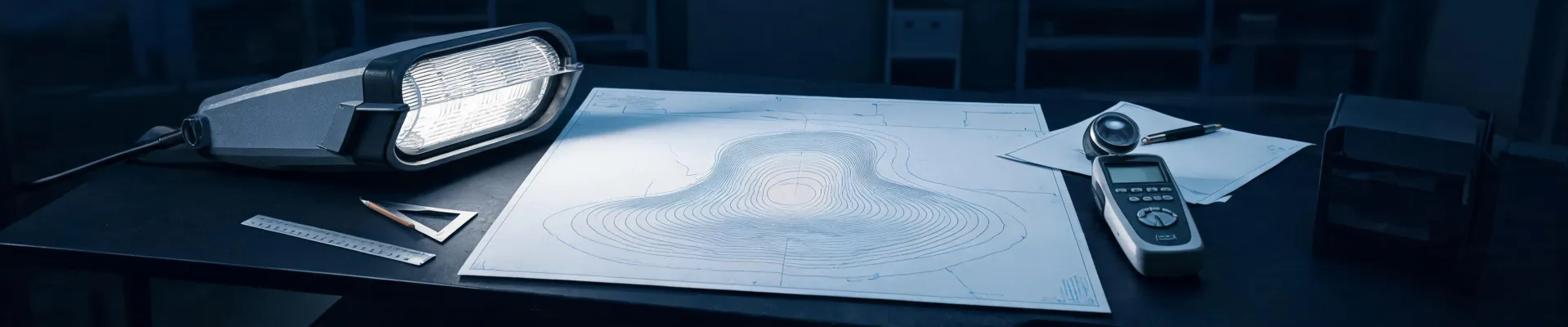
Lumens, CCT, CRI, and distribution type. Get all four in writing. Get the IES file too.
What most people don't realize is that "20,000 lumens" can mean fixture lumens or delivered lumens — and the gap between those two numbers is where the arguing starts six weeks later.
Checkpoints:
- Confirm whether the lumen figure is total fixture or effective output, and ask about LED lumen maintenance using the LM-79 / LM-80 / TM-21 framework
- CCT by number (3000K, 4000K, 5000K). "Warm white" means different things to different suppliers, and even 4000K carries a tolerance — ask which bin
- Ask for the IES file. If a supplier can't produce one, the spec sheet is marketing material
- Run the layout in DIALux or Relux rather than trusting the illustration in the brochure. If you're handing someone a set of street lighting specifications, the photometric curve has to match the pole layout on the ground, not the render on the cover
Step 3 — Verify the electrical spec, then ask the surge question
This is the step most people skip. I learned that the hard way.
Start with the plain items: input voltage range, driver type, dimming protocol (0-10V, DALI, or internal), and power factor. Those are on the datasheet.
Then the surge question. In a lightning-heavy region, or anywhere on overhead lines, ask what surge rating the fixture itself carries and whether the driver is field-replaceable. A fixture with a sealed, non-replaceable driver is a different liability than one with a socketed driver, even at the same price.
I once saved $4 per fixture on surge protection across a 180-piece wall light order. Nine months later a grid spike took out nearly half the drivers. The service-side fix ran about $4,100 plus the kind of customer relationship damage that takes more than a quarter to heal. That $4 savings didn't come close to covering a third of it.
Step 4 — Verify compliance at quote stage, not shipping stage
The buyer — or the buyer's client — will ask for certificates. Chasing them while the container is on the water is a bad place to be.
Confirm in advance:
- Luminaire safety listing, e.g. UL 1598 or IEC 60598
- Ingress protection rating per IEC 60529 — the tested figure, not the marketing claim
- Impact resistance per IEC 62262
- Pole interface and photocell receptacle standards under the ANSI C136 series
- DLC listing where the project depends on a utility rebate
Ask for the original certificates, not a screenshot collage. Same rule for Schreder lighting as for any other brand.
Step 5 — Check brackets, accessories, and pole compatibility
Brackets, pole adapters, junction box layout, photocell receptacles, arms. Every one of these ends up on a surprise invoice somewhere down the line.
I had a 120-light order in 2023 that died on the accessory, not the fixture. The fixtures were fine — the mounting brackets didn't match the client's pole diameter. Reordering the adapters and expediting them ran $1,180 and stalled the line 6 more days. Nothing was wrong with the light. But the customer doesn't remember that distinction. They remember the delay.
Step 6 — Get warranty, spares, and end-of-life policy in writing
Verbal promises don't count. They don't.
Attach to the order:
- What the warranty covers — fixture body, driver, and coating often carry different terms, sometimes different years
- Spare availability through the project lifecycle (driver, optics, gaskets)
- End-of-life notice window — typically quoted as 6 to 12 months, but find out when the clock starts
- RMA process, including who eats the freight
I had a supplier discontinue a product line mid-order. They did send a notice — to a rep's email address we hadn't used in three years. By the time it surfaced, the line was already written into three project specs. Now end-of-life terms get attached to the PO itself, with a written acknowledgment back from the purchasing contact. One of my biggest regrets is not doing that from day one.
Step 7 — Quote on landed cost, not unit price
Multiply the unit price by quantity. Then add all of the following: installation labor, accessories, freight and duty, warranty callbacks, and replacement parts across a seven-year cycle.
Do the arithmetic. A $180 fixture versus a $240 fixture is $60 apart. On 200 units, that's $12,000 you're "saving." If the cheaper unit's driver fails earlier and has to be swapped on a lift — a job that runs roughly $80 to $250 per unit depending on height and whether it's live-work — the savings are gone on the first replacement. The second replacement is pure loss.
Installation labor for outdoor fixtures sits in roughly the $80 to $250 per-unit range (based on publicly listed contractor pricing, early 2026; verify current rates for your market). When installation costs more than the fixture itself, you should be selecting fixtures on a different basis. The price tag is the entry fee. The landed cost is what's at stake.
My take, from experience: the lowest quote has cost us more in the end on more than half the projects where we took it. Not because cheaper is inherently worse — because the quote didn't include the parts of the cost that show up later, and nobody asked.
Things that still trip people up
- Quoting before installation conditions are confirmed. It's faster than waiting for answers. It's also much more expensive than waiting for answers.
- Treating verbal commitments as real. If it isn't on the order confirmation, it doesn't exist. I still kick myself over a delivery-date promise from a few years back that we never put in writing. If I'd documented it, we'd have had grounds to dispute the late fee.
- Underestimating SKU count. An order of 120 fixtures might be 14 SKUs, each with its own packaging and label requirements. That alone adds days to a schedule most people plan around a single item number.
- Quoting what you have, not what the site needs. The quotes that win these projects are the ones where installation, certificates, and accessories were run through before the buyer ever saw a number.
Use the checklist in order. The order matters more than it looks.

Tomasz Zielinski is a lighting procurement and lifecycle analyst specializing in LED sources, drivers, commercial fixtures, industrial luminaires, outdoor systems, and controls. He relates IES LM-80 data and TM-21 projections to operating temperature, lumen maintenance, driver life, surge exposure, repairability, duty cycle, and replacement intervals. He writes balanced buying guides for teams comparing warranties, energy use, maintenance labor, spare-part support, supplier documentation, continuity of supply, and total ownership cost.