-
What you're actually comparing
-
Dimension 1: How photometric claims are generated
-
Dimension 2: Housing and IP rating — where "expensive = better" breaks
-
Dimension 3: Driver sourcing — the component that actually kills you
-
Dimension 4: OEM flexibility vs. spec consistency
-
Dimension 5: Warranty language — who pays when it fails
-
How to choose — by channel, not by "best"
What you're actually comparing
Somewhere around the 40th wall light sample I pulled apart, the pattern became obvious. Two suppliers. Same lumen output on the datasheet. Same 4000K CCT. Same IP65 claim. Same price band, within 4%. Physically? One had a die-cast aluminum housing with a real silicone gasket and a driver I recognized. The other had a stamped sheet-metal body, a foam gasket that would give up in its second summer, and a driver with a brand label I'd never seen and a field failure rate I later measured at just under 4%.
On paper, they were the same product. On a test bench, they were not close.
Look, most buyer comparison happens on paper — spec sheets, catalog listings, price per unit. Manufacturers know this. So the comparison that actually matters isn't "brand A vs. brand B" or "Schreder vs. regional supplier." It's compliance-led manufacturers vs. price-led manufacturers, and both types exist in every price band, every country, every channel.
I work on the receiving end of this: quality and brand compliance for an outdoor lighting distributor. I review every production batch before it reaches customers — roughly 180 SKUs a year across outdoor categories. In 2024, I rejected 22% of first deliveries for non-conformance. That's not a typo. Nearly a quarter of "in-spec" batches failed on physical verification.
Here's the framework I use. Five dimensions. Each one splits compliance-led and price-led suppliers cleanly.
Dimension 1: How photometric claims are generated
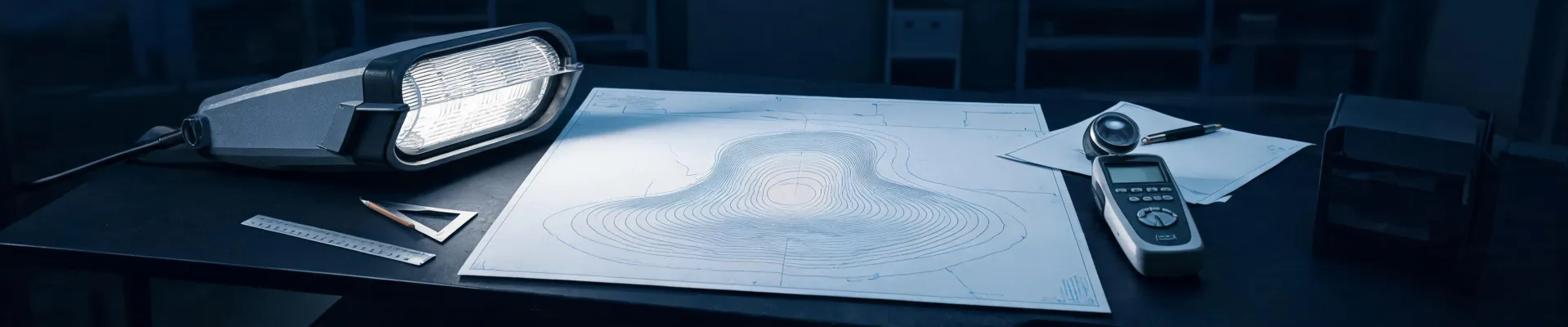
Compliance-led suppliers publish LM-79 test reports from accredited labs, with the actual IES file available on request — sometimes just attached to the spec PDF. The lumens on the box match the lumens in the IES file, and if you integrate them into DIALux or AGi32, the numbers hold up.
Price-led suppliers mostly do something else. They quote "rated lumens" from the LED chip datasheet at 25°C junction temperature, apply a generous optical efficiency factor, and call it the product's output. That number has almost nothing to do with the delivered lumens at operating temperature, in a housing that's been warm for six hours.
Reverse the assumption for a second. Buyers assume a higher quoted number means a brighter fixture. The reality is often the opposite: the fixture with the lower printed number delivers more light, because that number came from a full integration test rather than chip multiplication.
The check: ask for the LM-79 report. If they send a chip datasheet instead, you have your answer.
Dimension 2: Housing and IP rating — where "expensive = better" breaks
Here's a good one. People think expensive suppliers deliver better housings. Actually, suppliers who deliver better housings can charge more. Causation runs the other way, and the price tag alone tells you almost nothing.
I've seen $60 fixtures with proper die-cast housings and marine-grade powder coat, and $140 fixtures that would show rust staining on the base bracket within eighteen months in coastal installations. The IP65 label isn't the differentiator — the gasket material and the housing coating are.
Compliance-led wall light manufacturers will tell you the gasket compound (silicone, EPDM, or the foam stuff), the powder coat spec (typically a 3-stage pretreatment with chromate conversion, or anodization for aluminum), and they'll offer a salt-spray test result — usually ASTM B117 at 1,000 hours minimum for outdoor applications. That's not marketing, that's documentation.
Price-led suppliers say "IP65, outdoor rated, aluminum." That's the language of a catalog, not a spec.
Dimension 3: Driver sourcing — the component that actually kills you
Not ideal, but here's the honest version: the housing will outlive the driver every time. The driver is where most outdoor fixture failures originate, and it's the one component most buyers never ask about.
Compliance-led suppliers name the driver. Meanwell, Philips Xitanium, Inventronics, Tridonic — something traceable with a published MTBF and a warranty you can actually enforce. They'll also tell you the surge protection rating. For exposed outdoor installations, 10kV/10kA is the standard you want; anything below 6kV is a red flag.
Price-led suppliers use "high-quality driver" in the spec sheet, which is a phrase, not a specification.
I made the classic rookie error on this in my first year: I approved a private-label batch of 600 area lights without naming the driver in the PO. Every unit came with a no-name driver rated for 6kV surge. Coastal deployment. We replaced 41 drivers in year one. That was a $7,400 lesson and it's still embarrassing.
Now every contract I touch includes the driver make, model, surge rating, and whether the manufacturer reserves the right to substitute. They usually try to reserve that right. Hold the line.
Dimension 4: OEM flexibility vs. spec consistency
For OEM and private-label buyers specifically, this is where the two supplier types diverge most sharply.
Compliance-led manufacturers will do OEM work — Schreder outdoor lighting, for example, has a route for distributors who want private-label variants — but they'll typically lock certain parameters. The photometric engine stays fixed. The housing stays fixed. What you customize is branding, packaging, CCT options, mounting brackets, maybe controls. That's the trade: you get a component with a paper trail, and you give up some carte blanche.
Price-led OEM suppliers will let you customize almost anything. Different housing, different LEDs, different driver, different CCT, printed logo on the front. The problem is consistency between batches. Batch 1 and batch 4 look the same on the invoice. On the photometric report, they don't. Colors drift. CCT shifts 200–300K. Occasionally a sub-supplier change goes unannounced.
For an outdoor lighting distributor selling under their own brand, that drift is the whole game. Your customers don't compare you to Schreder lighting. They compare batch 4 to batch 1 — the same SKU they bought six months ago.
Dimension 5: Warranty language — who pays when it fails
The last dimension, and the one that catches the most distributors off guard.
Compliance-led suppliers write warranties with defined remedies: replacement, credit, or rework, with a stated response window and a burden of proof that doesn't require you to ship the failed unit across an ocean on your own dime.
Price-led suppliers write warranties that say "5 years" and then list exclusions in the footnotes: acts of God, improper installation, environmental conditions exceeding specifications, use of non-approved components. By the time you've read the exclusions, pretty much every reason a fixture actually fails is on the list.
I ran the numbers on this once. Two suppliers, same nominal warranty period. One had a 68% claim acceptance rate over three years. The other, 11%. Same price band. Which one was actually cheaper on a bulk wall light order of 2,000 units? Not the one with the lower FOB price.
How to choose — by channel, not by "best"
Here's the practical decision rule I give new buyers on my team.
Pick compliance-led suppliers when:
- You sell under your own brand and can't afford spec drift between batches
- Your channel sells into spec-driven projects (municipal, sports facilities, hospitality)
- You or your customers need photometric files for design software
- You can support a higher unit price with documentation and warranty claims you can actually pursue
Pick price-led suppliers when:
- You're selling commodity replacement fixtures where "close enough" is the market standard
- Price is the actual purchase driver and the customer knows it
- You can absorb 15–25% field failures and have factored that into your margin
- You have no intention of building a brand around the product
Both models are legitimate. The mistake is picking price-led and expecting compliance-led behavior, or the other way around. The spec sheet will look identical either way. Only the driver, the gasket, and the warranty acceptance rate tell you which one you actually bought.
The numbers said cheap. My gut said look at the driver first. I've stopped trusting the numbers on their own.

Fatima El-Sayed is a commercial indoor lighting analyst specializing in recessed lighting, downlights, ceiling lights, panels, under-cabinet fixtures, pendants, and wall lights. She applies EN 12464-1 workplace-lighting criteria through maintained illuminance, uniformity, UGR, vertical light, color rendering, task areas, and maintenance factors. She writes specification guides for project teams comparing layouts and fixture types across offices, retail, hospitality, and education against visual tasks, energy targets, ceiling conditions, and occupant comfort.