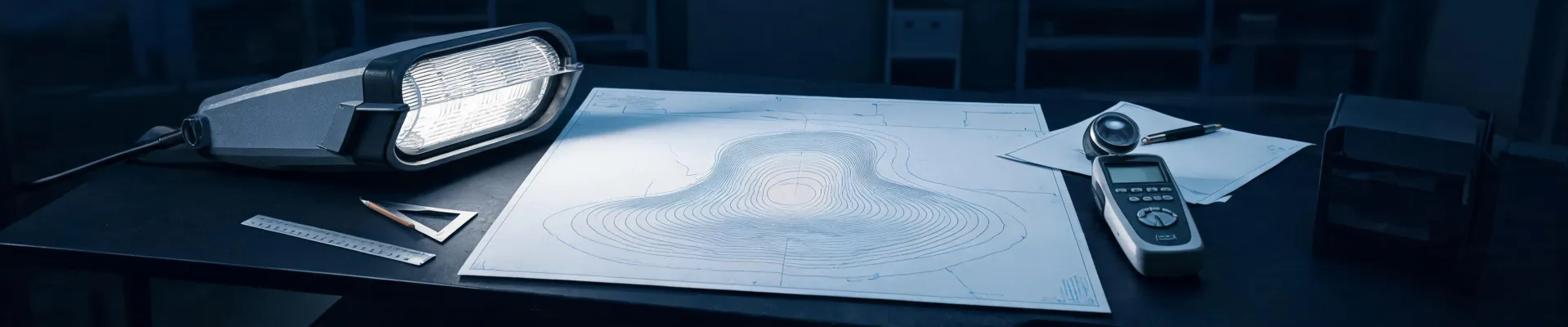
March 18, 2024. I remember the date because I nearly clicked “approve” on a $98,400 order for LED flood lights. My mouse was hovering over the button. If a junior engineer hadn’t walked over with a question about pole placement, we probably would have signed it.
That order would have been a mistake. Not because the fixtures were necessarily bad, but because we were comparing the wrong things. We were buying on price when we had not defined what the light needed to do on the field.
Let me back up.
The project looked simple
I’ve managed procurement for a regional electrical contractor for eight years. Outdoor lighting is one of my main spend categories: parking lots, street lighting, and flood lights for municipal clients. We spend about $420,000 a year on it, and every order gets tracked through our cost system. I’m the person who argues for the more expensive option when the cheap one will cost more later.
In February 2024, we won a contract to relight a youth sports complex with two soccer fields. The deadline was real: the facility opens in September, so the lighting had to be delivered and installed by August. That left a tight ordering window.
The client’s requirement, in their own words, was “good quality sports lighting that meets the standards.” We turned that into a request for quotes that was, honestly, a shopping list. Voltage, wattage, IP rating, mounting height. We asked for “LED sports flood lights” and let the suppliers decide the rest.
That was our mistake. A wattage number is not a specification. “Meets standards” is not a target.
Three bids, a wide price spread
We sent the RFQ to five flood light suppliers. Two declined because they didn’t serve our region. Three came back with quotes, and the spread was hard to ignore:
- $197,000 from a national brand. Detailed proposal, but with extras we did not need.
- $129,500 from Schreder. Clean quote, and it included photometric design files before we even asked for them.
- $98,400 from an online wholesale supplier. Similar fixture count, about 25% below the next-lowest bid.
If you do cost control for a living, your eyes go straight to the lowest number. Mine did. My project manager started planning where to spend the savings. My boss asked why we would ever pay more.
But here’s the thing: a good chunk of my career has been cleaning up decisions that looked great in a quote comparison. The more I stared at the $98,400 proposal, the more uncomfortable I got.
The package didn’t include a photometric layout. There were no glare calculations, no uniformity ratios, no mention of lighting controls. The one-page datasheet described a beam pattern aimed at warehouses and open yards, not at a soccer pitch where players need to track a moving ball.
So I asked all three bidders three simple questions:
- What maintained illuminance does your design deliver at the center of the pitch and near the goal lines?
- What uniformity ratio does the design achieve across the playing surface?
- Will you share the photometric files and the calculation report?
The answers told me everything I needed to know.
One sentence changed the decision
Schreder replied the next day with a full design report. Every number traced back to a photometric calculation. They also flagged two pole positions that would create coverage gaps and offered alternatives before we had even asked.
The low-price supplier replied with a sentence I will never forget: “We don’t normally provide photometric design services at this price point.”
That should be printed on a warning label. If a flood light supplier cannot show you the photometric design for a sports field, they are selling hardware, not lighting. And we were about to buy hardware for a project that needed lighting.
I still hesitated. The price gap was real: choosing Schreder meant spending $31,100 more than the low bid, and my boss was pushing hard. The spreadsheet said one thing. My gut said another.
We compromised. Instead of signing either proposal, we paid $3,800 for an independent lighting consultant to model all three bids against the actual field geometry and the applicable sports lighting recommendations.
The report was uncomfortable to read. The cheapest option would have produced patchy light on the playing surface, with dark zones between poles and glare that would affect both players and neighboring properties. The field would have been technically “lit,” but the distribution was wrong for the sport. Fixing it later meant new brackets, new aims, additional crane time, and delays past the opening date. The consultant estimated the correction cost at $22,000 to $28,000 — before counting the damage to our reputation with the client.
His closing line stuck with me: “You didn’t specify the performance. So the suppliers quoted equipment, not results.”
“You didn’t specify the performance. So the suppliers quoted equipment, not results.”
That is one of the most expensive sentences in procurement. It is also the easiest one to prevent.
What we changed before the next order
With the installation window closing, we went back to Schreder and rebuilt the scope around field performance instead of fixture count. They value-engineered the design for the same illuminance targets and adjusted the pole layout where the site allowed. Final price: $126,700.
That was still $28,300 above the low bid. But this time the bid came with calculations, an acceptance test procedure, and a design we could verify before any concrete was poured. We used the Illuminating Engineering Society’s RP-6 Recommended Practice for Sports and Recreational Area Lighting as our reference point, which made the discussion concrete: lighting class, lux targets, uniformity, and glare limits.
That experience became a checklist. Every sports lighting RFQ we send now includes:
- Illuminance and uniformity targets defined by the level of play, not left for bidders to guess.
- A requirement for photometric design files in every proposal.
- Glare and light spill limits tied to the site boundaries.
- A written acceptance test, performed after installation, with measured results compared to the design.
- Maintenance factors stated in the calculations, so we know what the field will look like in year five, not just on day one.
That checklist became the outline for a three-page sports lighting specification guide we now use internally. It has grown since, but the principle is the same: define the outcome before you ask for a price.
The season after
We commissioned the system in August 2024. Measured photometrics on site landed within 5% of the design values. Zero glare complaints from neighbors. Zero calls from referees. Energy consumption is running about 18% below what the utility allowance estimated for the site.
Since then, we have used the same review process on three more outdoor lighting projects, including a multi-field facility where we ordered bulk sports lighting as part of a larger package. We caught two compliance issues during the bid stage instead of after the poles were up. That alone paid for the consultant many times over.
Did we choose Schreder outdoor lighting every time after that? No. But the suppliers who win our work now are the ones who bring the same level of engineering transparency. Do I still care about price? Absolutely. Cost control is my job. I just learned that in sports lighting, the specification is the cheapest component in the whole project. It costs nothing but attention.
The $3,800 we spent on review saved us from an estimated $25,000 correction and a ruined opening weekend. That is the best return on any procurement expense we had that year.
Five minutes of verification beats five days of correction. That’s not a slogan. It’s a budget line.
Project pricing based on March 2024 quotes for a two-field soccer complex in the US Midwest. Actual pricing varies by location, pole requirements, and specification level. Verify current pricing with suppliers.

Clara Whitmore is a lighting photometry and LED source analyst specializing in bulbs, tubes, strips, panels, and integrated luminaires. She interprets IES LM-79 measurements and TM-30 color rendition data through luminous flux, efficacy, intensity distribution, CCT, chromaticity, fidelity, and gamut metrics. She writes evidence-led comparisons for specifiers selecting source formats and luminaires for commercial interiors, industrial spaces, or horticultural systems where measured optical and color performance matter.