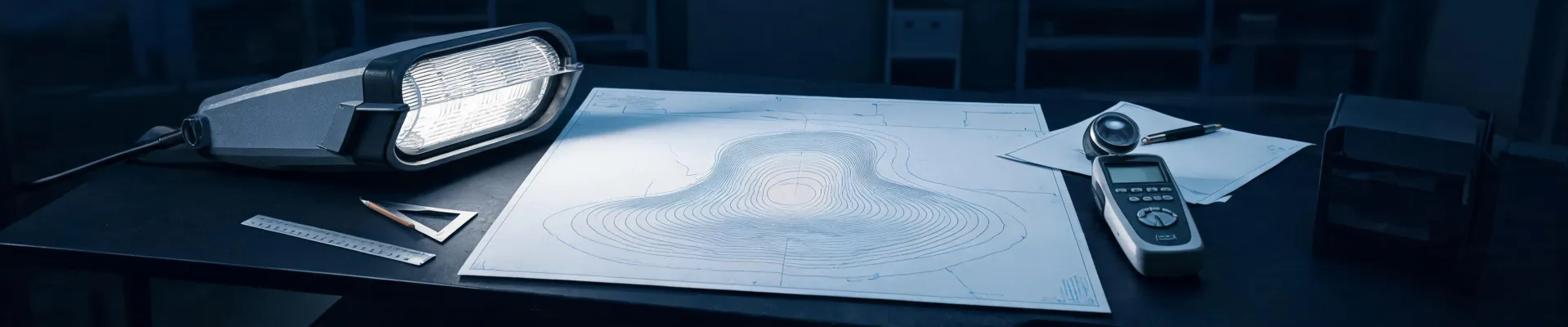
I still remember the afternoon a sales manager put a flood light quote on my desk. The unit price was 16% lower than anything we had paid for a comparable outdoor sports fixture. That number looked good. Too good, maybe. But my job is not to get excited about prices. My job is to stop bad products from leaving our warehouse.
I am a quality and compliance manager at a lighting distributor. I review about 200 product configurations every year, including flood lights, wall lights, area lights and the drivers inside them. In our Q1 2024 audit, I rejected roughly 8% of first samples from new suppliers. Not because every light was dead. Because the actual product did not match the documents that were supposed to prove it was safe and fit for purpose.
A flood light private label request with an uncomfortable shortcut
The quote became a bigger project when the sales manager explained that the customer wanted their own brand on the product. A flood light private label order is not just a purchase. The customer's name goes on the housing. If the product fails, no one remembers which factory made it. They remember the brand on the label.
The low-cost supplier promised a sports-rated flood light with all necessary approvals. The sample arrived quickly. The approvals did not. We received a one-page datasheet, a photo of a different fixture, and a certificate for a model number that was not the one we were evaluating. The supplier said we could get the photometric file from the LED chip maker. That is not how a complete fixture specification works.
I asked whether the flood light had been tested with the same driver model listed in the quote. The supplier said the driver could be changed without affecting certification. (Ugh.) That sentence alone moved the quote from low-cost to high-risk. Changing a driver can change surge performance, thermal behavior, and safety data. A responsible OEM confirms the complete assembly, not just the LED board.
Sports lighting compliance requirements are the real test
Sports lighting compliance requirements are not one checkbox on a tender form. They can include illuminance levels and uniformity for the sport, glare control, spill light limits, surge protection, ingress protection test evidence, and photometric files in a format a lighting designer can open. Depending on the country, engineers also reference standards such as EN 12193 or IEC 60598. The project owner decides which ones apply.
Label claims matter too. Under the FTC Green Guides, environmental marketing claims need reliable evidence. If a box says eco-friendly or recyclable without a specification behind it, that is another documentation gap. Vague green labels are not a technical benefit.
I asked the low-cost supplier for the same information I would ask any OEM: an IES file for the exact configured product, driver specifications, mechanical drawings, and a declaration of conformity that matched the product code. The supplier went quiet.
Why Schreder outdoor lighting won the total cost review
At that point I contacted a local Schreder representative. I had reviewed Schreder products for an earlier parking lot range, so I knew they were not always the fastest to quote. I also knew their technical team would not send a vague datasheet.
For the flood light private label project, Schreder proposed a fixture from its Schreder outdoor lighting range. The unit price was about 12% higher than the low-cost quote. On 120 units, that was still real money. But I calculated total cost, not unit cost.
Total cost included the price, freight, hours my team spent chasing documents, risk of delivery rejection at the sports site, and the cost of handling a warranty claim after installation, which includes travel, not just the replacement fixture. I did not invent an energy saving payback because that depends on the actual project. I did include a conservative rework cost if the wrong product reached the field. Once I put those numbers in the same spreadsheet, the Schreder quote was not more expensive.
What made the difference was documentation. Schreder gave us IES files, driver details, wiring diagrams, label artwork guidelines, and a clear statement about which sports lighting compliance requirements could be confirmed by calculation and which depended on site setup. No vague promises. No we can fix it later.
The order that nearly went the other way
I have mixed feelings about how close we came to signing the lower quote. Part of me still understands the sales manager's pressure: the customer had a budget, and the cheap supplier was offering a quick win. Another part remembers how many times a missing certificate turned into a 3 a.m. email.
Dodged a bullet? Yes. We were one signature away from ordering 120 flood lights without verified photometrics or exact model certification. So glad we checked twice. Almost went with the lower quote, which would have meant explaining a sports lighting compliance gap to the customer after installation.
Honestly, I am not sure the cheap fixture would have failed for every buyer. My best guess is that some units would have worked fine. But a private label launch cannot rely on luck. Sports lighting compliance requirements can be strict, and a rejected batch after installation costs way more than the initial price difference.
What that taught us for wall lights and future OEM work
The same checklist now applies to every new private label product, including a wall light range we added later in the year. When the wall light request arrived, we asked the same questions up front. It took one conversation because Schreder lighting already had the folder prepared. That is what engineering support should look like.
If you are comparing suppliers for an outdoor lighting private label project, ask for the compliance file before you ask for the final discount. Request documents for the exact model number. Ask how the supplier handles project-specific calculations. And if a supplier says the details will come later, remember what later means in a production schedule. It means after you have already committed.
Sports lighting compliance requirements are the part of a quotation that too many suppliers hope you will skip. We are no longer willing to skip them. And I still do not fully understand why some factories invest so much in the housing and so little in the paperwork that proves the product works. If someone has a good answer, I would love to hear it. Until then, we will keep using the Schreder outdoor lighting documentation as our reference for what complete looks like.

Clara Whitmore is a lighting photometry and LED source analyst specializing in bulbs, tubes, strips, panels, and integrated luminaires. She interprets IES LM-79 measurements and TM-30 color rendition data through luminous flux, efficacy, intensity distribution, CCT, chromaticity, fidelity, and gamut metrics. She writes evidence-led comparisons for specifiers selecting source formats and luminaires for commercial interiors, industrial spaces, or horticultural systems where measured optical and color performance matter.