-
Who should use this checklist
-
Step 1: Lock down the deliverable specification, not just a wattage
-
Step 2: Verify compliance and certifications before you compare unit prices
-
Step 3: Get a truly all-in quote
-
Step 4: Confirm OEM/private-label details in writing
-
Step 5: Validate with photometric simulation or a physical sample
-
Step 6: Confirm logistics, site access, and unloading plans
-
Step 7: Use payment terms as a risk lever
-
Common mistakes that turn emergencies into disasters
-
Final reminder
Need bulk street lighting in two weeks instead of eight? This is the checklist I pull out when a project deadline goes sideways. It covers street lighting, flood lighting, and OEM/private-label orders, and it's built around real rush scenarios: a parking lot expansion, a public works tender deadline, a contractor who just discovered the mounting bracket was wrong. This is not procurement theory. It's what worked across 200+ expedited orders, including 47 last quarter with 95% on-time delivery.
Rush orders are where mistakes get expensive. Slow down for five minutes and run this list before you commit.
Who should use this checklist
If you are a distributor, wholesaler, or OEM buyer responsible for sourcing Schreder outdoor lighting or another reputable manufacturer's equipment, this is for you. It also works if you're choosing a flood light OEM partner for a private-label line. The steps apply whether you're buying 30 fixtures or 3,000.
Why does this matter? Because in a hurry you naturally focus on the fastest path to a PO. That instinct is correct, but it sidesteps the details that later become change orders. Let me rephrase: in a rush, every mistake multiplies because there's no time to recover.
Step 1: Lock down the deliverable specification, not just a wattage
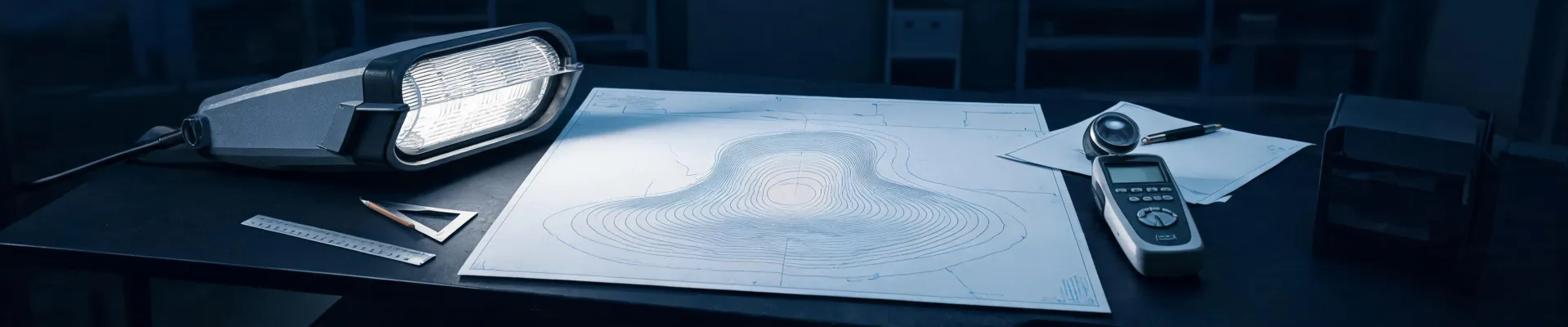
Most buyers focus on wattage and lumen count. They miss distribution type, CCT, voltage, surge protection, mounting interface, and the photometric file. On a street light, the photometric file is the DNA of the fixture. One 60W LED fixture can have a Type II roadway pattern; another 60W with a Type V pattern can light an intersection. You don't want to discover that after the fixtures land.
So when I say 'specification,' I mean seven things: driver input voltage, surge suppression, CCT, delivered lumens (not chip-level lumens), beam distribution, mounting interface, and ingress protection rating. If a vendor can't produce these specs quickly, that's a sign the product might not be ready for a serious procurement process.
The question everyone asks is 'how many watts?' The question they should ask is 'what is the IES file?' No IES file, no approval.
Step 2: Verify compliance and certifications before you compare unit prices
Compliance is the biggest hidden-cost category in outdoor lighting. In North America, street lighting often requires UL 1598, DLC, or both. In Europe, CE and EN 13201 apply for many road lighting projects. On municipal work, missing certification can mean rejected goods, lost grants, or a redesign at your expense.
Always request the actual test report with a report number. A screenshot from a marketing brochure is not evidence. Per FTC Green Guides (ftc.gov), environmental claims need substantiation. If a supplier claims '50,000-hour life,' ask for an LM-80/TM-21 report. A label that says 'eco-friendly' is not a spec; it's a suggestion. And before you ask about pricing, make sure the certification matches the product version you're buying. Some catalogs list a certificate for a similar family, not the exact model.
Step 3: Get a truly all-in quote
Unit price is the starting line, not the finish line. In many rush purchases, packaging, crating, freight, customs, expediting fees, and fuel surcharges add 30-50% to the total. I've learned to ask what's not included in this price? before asking 'what's the price?'
Last year, a distributor in the Midwest chose a line of flood lights with a unit price $22 lower than the next bid. The final invoice included $6,800 in crating, $3,100 in expediting, and freight by the time the fixtures arrived. The competitor with a higher unit price but a transparent breakdown came in $4,000 less overall.
The vendor that lists all costs upfront—even when the total looks higher—usually costs less in the end. That's one of the few things I'll state with confidence.
Step 4: Confirm OEM/private-label details in writing
If your order is flood light OEM or private-label, every minor detail can cause a delay. Housing color, logo placement, label text, box markings, instruction manuals, even the default app name if the fixture is smart. During a rush order, verbal approval is worthless. Written approval is what the factory will follow.
Always request a detailed approval drawing in PDF. Should mention: we also ask for a photo of the first finished unit before the full run is finished. It costs one day but prevents a full batch with the wrong logo or a reversed wiring diagram.
Step 5: Validate with photometric simulation or a physical sample
Fast-track does not mean skip validation. If a physical sample isn't possible, at least run an AGi32 or DIALux simulation using the vendor's IES file. This will show illuminance levels, uniformity, and glare conditions at your exact pole height and spacing. That's the core of a good flood light specification guide.
The advice 'compare lumens per watt' ignores beam distribution, mounting height, and pole spacing. A high-lm/W fixture with a narrow beam can leave the edge of a parking lot dark. A photometric simulation removes the guesswork far better than a brochure chart.
Step 6: Confirm logistics, site access, and unloading plans
Bulk street lighting usually moves LTL freight or full truckload, not parcel. A truck cannot offload 80 pallets without a forklift or dock. Confirm site access, gate height, and whether there is staff to unload. Add a two-day buffer between delivery and installation day. It's easier to store a few pallets than to explain why a crew is idle.
We once had an expedited order delivered on time, but the site was closed for two days due to another contractor's work. The crew stood idle and the client paid for a weekend installation. The fixture was on time; the project was late.
Another logistics point: compare the supplier's factory location with your project location. A supplier two states away is not always quicker than an overseas supplier with a US warehouse. We've shipped from Asia to the US west coast in eight days, but customs clearance took four. For neighboring countries, LTL freight can be slower than air freight. Match the mode to the deadline.
Step 7: Use payment terms as a risk lever
On a rush order, don't pay 100% upfront. A standard arrangement is a deposit to secure production and balance against shipping documents. If a supplier insists on full payment before a committed ship date, view that as a warning.
That said, custom OEM work with accepted drawings and unique components is different. A larger prepayment can be normal. Just make sure the delivery date is written in the same contract as the payment terms.
Common mistakes that turn emergencies into disasters
A few patterns come up over and over.
- Re-using an old spec. Photometric files and drivers change without notice. Confirm current catalog numbers before copying an old bill of materials.
- Ignoring import requirements. A commercial invoice with the wrong HTS code can hold a container in customs for weeks. Ask your vendor for the incoterm and required documents.
- Skipping photometric validation. This is how dozens of fixtures end up with the wrong optics. Even a simple simulation beats a guess.
- Taking a printout as proof of certification. Look for a report from a recognized lab with a test number you can verify.
- Forgetting the human side of unloading. Product can be on time but still late if the dock can't receive it.
Final reminder
I've only worked with North American and EU projects for the past few years. If you're sourcing in other regions, compliance and logistics steps will differ. But the discipline of asking what's included, verifying photometric data, and keeping a paper trail always transfers.
Whether you're ordering Schreder lighting or any other approved product, this checklist keeps the process honest. Before you send the PO, read step three one more time. The cheapest quote is rarely the complete one. In a deadline-driven order, surprises should only happen on paper—not on the final invoice or the delivery dock.

Clara Whitmore is a lighting photometry and LED source analyst specializing in bulbs, tubes, strips, panels, and integrated luminaires. She interprets IES LM-79 measurements and TM-30 color rendition data through luminous flux, efficacy, intensity distribution, CCT, chromaticity, fidelity, and gamut metrics. She writes evidence-led comparisons for specifiers selecting source formats and luminaires for commercial interiors, industrial spaces, or horticultural systems where measured optical and color performance matter.