-
Questions This Guide Answers
-
What Exactly Is Schreder Outdoor Lighting?
-
What Should You Ask Before Quoting a Schreder Outdoor Lighting Project?
-
Why Is Photometric Data More Important Than Lumens?
-
Can Schreder Be a Flood Light OEM Partner?
-
What's a Realistic Sports Lighting Wholesale Cost Guide for 2026?
-
How Do You Become a Sports Lighting Distributor for Schreder?
-
When Should You Not Use Schreder Outdoor Lighting?
If you're researching Schreder outdoor lighting for a distribution line, an OEM program, or a sports lighting project, you probably have questions. I've been on the buyer's side since 2018. I manage purchasing for a mid-size electrical distributor, so I'm not an engineer. But I've read enough photometric reports and warranty terms to know what actually matters. This FAQ covers the questions our own team asks before we order Schreder products.
Should mention: this is a buying-side perspective, not an official Schreder training manual. So I'll focus on what you need to ask, not just the marketing answer.
Questions This Guide Answers
- What exactly is Schreder outdoor lighting?
- What should you ask before quoting a Schreder job?
- Why is photometric data more important than lumens?
- Can Schreder be a flood light OEM partner?
- What's a realistic sports lighting wholesale cost guide for 2026?
- How do you become a sports lighting distributor?
- When should you skip Schreder and use something else?
What Exactly Is Schreder Outdoor Lighting?
Schreder lighting is a Belgian outdoor lighting brand. Its range covers street lighting, sports lighting, wall lights, flood lights, and area lights. For B2B buyers, the appeal is having one supplier across multiple outdoor categories. We use their fixtures when a project needs documented performance and support rather than the lowest upfront number.
I'll be honest, the decision to add Schreder to our catalog wasn't obvious. We went back and forth with another supplier that offered better upfront pricing. That supplier also had a shorter delivery time. In the end, support and compliance won. That trade-off is worth knowing before you start quoting.
If you see Schreder written as Schréder, it's the same brand. Both spellings show up in Europe, so don't assume they are two different companies.
What Should You Ask Before Quoting a Schreder Outdoor Lighting Project?
Don't start with price. Start with compliance and photometric files. Ask for:
- IES files in .ies or .ldt format
- Driver brand and surge protection rating
- IP and IK rating
- LM-80/TM-21 lumen maintenance data
- Warranty terms, including what is excluded
Most buyers focus on per-unit pricing and completely miss the paperwork. I did the same when I started. In 2022, I accepted a quote for a flood light with no test data. The fixture failed within 18 months, and the replacement cost plus labor came to about $2,300. Now I verify test reports before I issue a PO.
According to IES standards (ies.org), photometric testing for LED luminaires is covered by LM-79, and lumen maintenance projections follow LM-80 and TM-21. In the U.S., many commercial outdoor lighting rebates are often tied to DLC listing (Source: DLC Qualified Products List, 2026). If the supplier can't provide those documents, that's a red flag.
Why Is Photometric Data More Important Than Lumens?
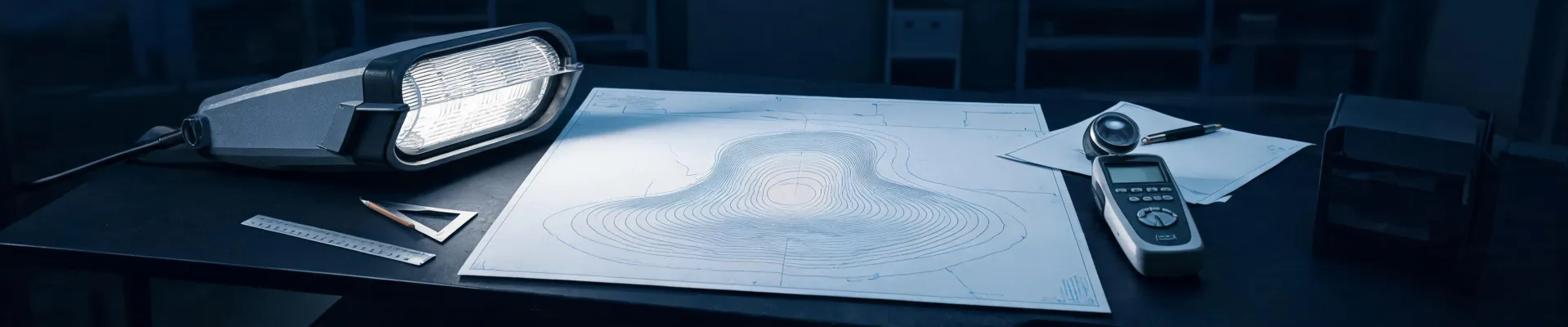
People think more lumens means brighter light. Actually, how the fixture distributes light determines whether a parking lot or sports field gets usable illuminance. Two fixtures can have identical lumen output, and one can look noticeably better because it puts light where it's needed and limits glare.
For outdoor sports lighting, this is not a minor detail. Ask for an illuminance calculation using the .ies file and your project layout. The question to ask isn't 'how many lumens is it?' It's 'what does the distribution curve look like?'
This is one of the most common mistakes I see in purchase requests. A higher-lumen fixture with the wrong distribution can leave corners dark and create light spill toward neighbors.
Can Schreder Be a Flood Light OEM Partner?
Yes, but it's not a quick white-label arrangement. Schreder supports OEM and private label programs, but it's a more collaborative process. You need to define output options, control protocols, voltage choices, packaging, and after-sales warranty responsibilities. Their value is in optical design and compliance help, not in being the cheapest flood light OEM.
If you need a simple flood light with your logo at the lowest possible cost, there are better places to source that. Schreder makes sense when the product has to perform to a specification and you need a manufacturer that can back it up with test data and field support.
At least, that's been my experience working with mid-size OEM quantities. The conversations are longer, but the product is easier to stand behind.
What's a Realistic Sports Lighting Wholesale Cost Guide for 2026?
I want to be careful with this one because sports lighting costs depend on pole height, lux targets, controls, and local labor. There is no single wholesale price list that works for every job.
In our Q1 2026 bid process for a high school soccer field, LED sports floodlights in the 1200W to 1500W range came in around $400 to $900 per fixture, depending on optics and controls. The total project cost was about $65,000 for four poles, twelve fixtures, wiring, and installation. That was a wholesale price level in our region, not a national average.
I might be misremembering the exact per-fixture range, so verify current pricing with local distributors. But the broader point stands: budget for the system, not the fixture.
Most buyers don't realize the fixture is often less than half the sports lighting project cost. Poles, foundations, wiring, and commissioning can be more than the lights themselves. If anyone gives you a sports lighting wholesale cost estimate without a proper site layout, treat it as a starting point, not a firm quote.
How Do You Become a Sports Lighting Distributor for Schreder?
The path depends on region and product line. In our case, we first bought Schreder through a regional distributor for several projects. After about two years of consistent volume, the manufacturer approached us about becoming a stocking distributor for the area.
If you want to be proactive, send a professional inquiry to Schreder with your service area, target customer types, existing electrical contractor relationships, and any sports facility projects you have supported. Be specific. A distributor that brings photometric calculation skills and installation partners is more attractive than one that just stocks boxes.
Also consider your warranty and spare-part workflow. Sports lighting distributors need to handle controls, poles, and after-sales support. That requires more than a warehouse. It requires people who can answer a maintenance call.
When Should You Not Use Schreder Outdoor Lighting?
This is the question that doesn't come up in most spec sheets, but it should. If your customer needs the absolute lowest upfront price, a regional import brand or a lower-specified fixture may win. Schreder is not the cheapest option, and I would not put it in a bid where price is the only score.
Also, if the project is small and can't support the required documentation and controls, Schreder's strengths may be underused. To be fair, there are projects where a simpler fixture makes sense. The key is matching the product to the project, not forcing a premium brand into every quote.
That said, for municipalities, schools, and commercial sites that will need replacement parts in five years, the total cost of ownership usually favors a manufacturer with local support and compliance records. I'd rather explain to a customer why we chose a more expensive fixture than explain why a cheap one died before its warranty ended.
Clara Whitmore is a lighting photometry and LED source analyst specializing in bulbs, tubes, strips, panels, and integrated luminaires. She interprets IES LM-79 measurements and TM-30 color rendition data through luminous flux, efficacy, intensity distribution, CCT, chromaticity, fidelity, and gamut metrics. She writes evidence-led comparisons for specifiers selecting source formats and luminaires for commercial interiors, industrial spaces, or horticultural systems where measured optical and color performance matter.