-
Where This Perspective Comes From
-
Mistake 1: I Bought a Wattage Number Instead of a Light Distribution
-
Mistake 2: I Treated “IP66” as a Universal Guarantee
-
Mistake 3: The Voltage Verification I Skipped
-
Mistake 4: I Assumed All “3000K” Looks the Same
-
What This Means for Flood Light OEM and Private Label Buyers
-
The Checklist I Use Before Every Wholesale Order
-
Where This Advice Stops Applying
If you're choosing street lighting for wholesale, here's the conclusion before the backstory: the biggest money-waster in this business is not fixture price or brand tier—it's the gap between the specification you write and the conditions your fixtures will actually face at the installation site. Between 2017 and 2021, I personally made nine significant procurement mistakes, totaling roughly $12,400 in wasted budget. All nine came from incomplete specifications. None of them came from paying too little—or too much—for a fixture.
I now work as a technical account manager at Schreder lighting, helping wholesale distributors and OEM/private label buyers handle specification and compliance for outdoor lighting projects. And I maintain a written checklist—the one I wish I'd had as an importer—so our partners don't have to repeat the tuition payments I made.
Here's the short version, if you're scanning: verify the photometric file against the actual fixture, confirm the site's voltage and environment in writing, and put CCT tolerances into the purchase order. That covers roughly 90% of the mistake patterns I've cataloged. The rest of this article is the evidence behind that claim.
Where This Perspective Comes From
Before Schreder, I spent four years as an independent importer, buying street lights and flood lights from overseas factories and reselling them to local distributors. In that time, I made almost every mistake a wholesale buyer can make. The first year alone cost me about $2,600 in reorders and rejected goods. That was almost entirely because I trusted datasheets over verified reality.
When I compared the orders that went smoothly with the ones that failed—same product categories, similar price points, different levels of verification—I finally understood why the details matter so much. It wasn't luck, and it wasn't the factory's reputation. It was how carefully I had checked what I was actually buying versus what I thought I was buying. That contrast is the foundation of everything below.
The Schreder outdoor lighting range spans street lighting, sports lighting, wall lights, flood lights, and area lights. The discipline I describe applies across all of them. But street lighting is where the consequences are most visible, so that's what I've focused on.
Take this with a grain of salt: I'm not claiming the numbers below are statistically rigorous. They're my own records. But they're real records, and the patterns have held up across dozens of project specifications I've reviewed since joining the manufacturer side. Don't hold me to the exact dollar amounts, but the scale of each loss is accurate.
Mistake 1: I Bought a Wattage Number Instead of a Light Distribution
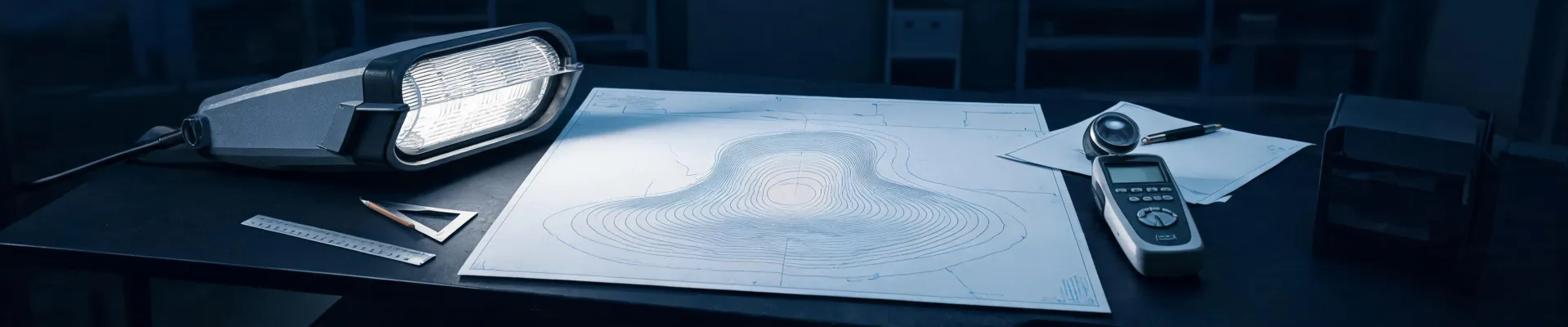
In September 2018, I ordered 180 street lighting fixtures for a residential development. The spec sheet promised 60W LED, 18,000 lumens, and a Type II distribution—ideal for that road geometry. I checked the wattage, I checked the lumen count, and I signed the purchase order. I did not check whether the IES photometric file actually matched the physical fixtures being shipped.
The factory had upgraded the optics in a new housing revision without updating the catalog's IES file. The real light spread was broader than the documented Type II, producing dark patches in the center of the road and spilling light into bedroom windows. The city engineer rejected the acceptance test based on uniformity ratios. Replacement optics kits and express freight cost about $1,500, plus a one-week schedule delay. The fixtures had the right total lumens. The distribution was wrong. Nobody remembered the spec sheet when they looked at that installation; they remembered the name on the mounting arm.
IES files are verification documents, not marketing decorations. If you can't line up the photometric file with the actual unit before committing to a volume order, you're gambling with your customer's street.
Mistake 2: I Treated “IP66” as a Universal Guarantee
In early 2021, I went back and forth between standard IP66 and marine-grade IP66 for an area lighting installation at a coastal marina. The decision kept me up at night. Standard IP66 met the contract requirement and saved around 6% on fixture cost. My gut said the salt air would punish the hardware within a couple of years. The paperwork said IP66 was sufficient. I chose the paperwork.
Within 18 months, 47 of 60 units showed gasket degradation and visible corrosion on the aluminum housings. The lights still ran, but the installation looked neglected, and the client's trust was gone. The replacement campaign cost about $2,300, and the relationship barely survived the argument about whose responsibility it was.
The “IP66 is always enough” thinking comes from an era when outdoor lighting hardware was replaced every five to seven years anyway. That's changed. LED fixtures are expected to operate for a decade or longer, which means housings and gaskets face environmental stress for much longer than anyone planned for. Coastal salt, industrial chemicals, extreme UV—all of those require explicit specification beyond the baseline IP rating.
If you ask me, this is also a brand problem. A distributor whose fixtures visibly corrode on a marina wall isn't just replacing hardware—they're rebuilding a reputation from a much weaker position.
Mistake 3: The Voltage Verification I Skipped
In Q1 2019, I submitted a purchase order for 80 street lighting fixtures with 240V drivers. The installation site was a commercial district with 347V line power. I checked that the fixture model was available in 240V. I did not check the actual voltage class of the site itself.
The electricians powered up the first batch and called me within minutes, describing “smoke and crackling sounds” before the crew cut the main breaker. Twenty drivers were destroyed, and the entire order needed re-driving. The cleanup cost $4,200 in parts and labor, plus a three-day production delay. It was the most expensive mistake in my catalog, and it could have been prevented by a single phone call. Looking back, it was kinda embarrassing how easily I could have avoided it.
Today, our team uses a two-signature rule: every purchase order includes the site's confirmed line voltage, verified in writing by the engineer or electrical contractor, and two people must sign off before the P.O. is approved. It takes five minutes. I wish I could go back to 2019 and add that five minutes.
Mistake 4: I Assumed All “3000K” Looks the Same
In 2020, I ordered a batch of 3000K street lights to extend an installation that had originally been supplied by a different manufacturer. Both product labels said 3000K. When the new fixtures went up, the mismatch was obvious immediately. The existing installation was measurably warmer—closer to 3400K in practice—and the street looked like a patchwork quilt at dusk.
It wasn't a safety failure. It was a persistent visual embarrassment that prompted complaints from the neighborhood and uncomfortable questions from city maintenance staff. Matching the color required about $400 in adjustments and a lot of awkward conversations.
Modern LED binning makes color consistency easy to get right, but only if you ask for the CCT tolerance band in writing. If you're extending an existing installation, get a physical sample of the new fixture and compare it side-by-side with what's already on the pole.
What This Means for Flood Light OEM and Private Label Buyers
If your business involves flood light OEM or private label distribution, the specification discipline matters even more. When you put your own brand on a fixture, the end user never thinks, “The factory must have sent a bad batch.” They think your brand doesn't stand behind its products. The verification process is an invisible part of the product—but it's the part that determines what your customers experience after installation.
Per FTC advertising guidelines, performance and environmental claims need to be substantiated with evidence. The same principle should guide your purchasing decisions. When a vendor quotes “50,000 hours,” ask for the LM-80 test report that supports that number. When they claim an IP rating, ask which standard and test method applies. If the documentation isn't available, that doesn't automatically disqualify a supplier—but it is a clear signal to do your own verification before committing large sums.
As an outdoor lighting supplier, Schreder provides specification and compliance documentation as part of its OEM support. I've seen what happens when buyers discover specification gaps late, and it's almost always more expensive than the verification itself would have been.
The Checklist I Use Before Every Wholesale Order
- Photometric file verification. Request the IES file and compare it against the actual fixture or an independent test report before volume purchasing.
- Environmental specification. Define the site's conditions in writing: coastal, industrial, high-UV, extreme cold, or high humidity. Specify corrosion protection, gasket materials, and operating temperature range beyond the baseline IP rating.
- Line voltage confirmation. Get the site voltage in writing from the engineer or electrical contractor. Include it in the P.O. Two-person sign-off, no exceptions.
- CCT tolerance and color bin. Put the tolerance range in writing. For installation extensions, compare a physical sample against the existing fixtures before ordering the batch.
- Third-party test documentation. LM-80 reports, IES files, surge protection ratings, compliance certificates. Store them with the order file so there's no ambiguity later.
Where This Advice Stops Applying
I don't want to overstate the value of this checklist. There are legitimate situations where the full verification process is overkill.
- Single-unit replacements. If you're buying one fixture to swap onto an existing pole, most of these steps don't add enough value to justify the effort.
- Government tender projects. Public procurement already includes deep photometric and compliance review before the P.O. is issued. If you're the approved supplier on a highway contract, the spec discipline exists upstream of you.
- Projects with an in-house photometric engineer. If your team has someone who's done dozens of similar installations, most of these checks happen naturally. The checklist is a backup, not a replacement.
One more nuance, for honesty: this is not an argument that premium brands are always worth it and budget options are always risky. I've seen budget fixtures perform well when the specification was tight. I've seen premium fixtures embarrass their buyers when installation realities didn't match assumptions. The variable that correlates with project success, in my experience, is not the brand tier. It's the completeness of the specification and the discipline of verifying it.
The quality your customers perceive on the street is determined months earlier, in a quiet office, before the purchase order is signed. That part of the work is invisible. But it's exactly what separates a brand that looks competent from a brand that looks careless, one installation at a time.

Clara Whitmore is a lighting photometry and LED source analyst specializing in bulbs, tubes, strips, panels, and integrated luminaires. She interprets IES LM-79 measurements and TM-30 color rendition data through luminous flux, efficacy, intensity distribution, CCT, chromaticity, fidelity, and gamut metrics. She writes evidence-led comparisons for specifiers selecting source formats and luminaires for commercial interiors, industrial spaces, or horticultural systems where measured optical and color performance matter.