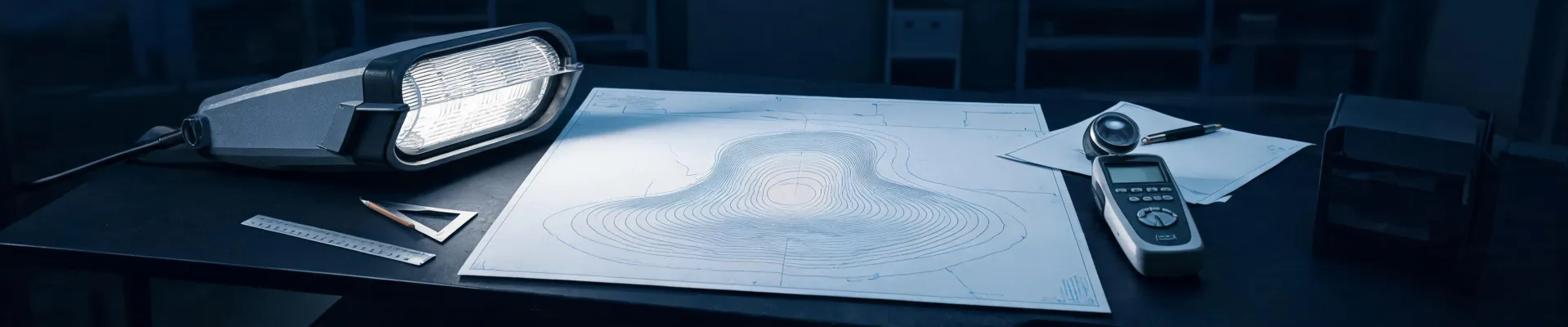
In September 2022, I was standing in a gravel parking lot in New Jersey with a clipboard and a problem. Forty-eight area lights were installed. The project inspector had just rejected the submittal because the delivered lumens did not match the photometric report. The fixtures looked fine. They hummed at dusk like they were working. But the numbers didn't lie.
I'm a sourcing coordinator handling outdoor lighting orders for eight years. I've personally made—and documented—six significant mistakes, totaling roughly $14,000 in wasted budget. That parking lot was mistake number four. Now I maintain our team's pre-order checklist to help other buyers avoid the same pain.
Where it started
In 2018, I moved into procurement at a small distributor. We did mostly outdoor site lighting, and our customers were small contractors. They didn't need a lighting designer. They needed fixtures that met local code and stayed on budget. So when a customer asked for area lights with their name on them, I assumed private label meant simple.
My thinking: choose a stock flood light OEM product, put a label on it, call it done. And honestly, that works in some categories. Not in outdoor lighting. Not when the city requires an approved submittal.
Everything I'd read about private label said it's a cheaper way to get your own brand without paying for R&D. In practice, I found the opposite: a private label is only cheaper if the documentation is already right. If it isn't, you pay twice.
The order that came apart
In August 2022, we quoted a customer 48 area lights for a small logistics yard. The customer wanted their brand on the fixture and asked me to source OEM area lights. I searched for flood light OEM suppliers, because in my head an area light was just a flood light with a different mounting. We got three quotes. The cheapest one came from a trading company, not a flood light manufacturer. The unit price was $92, about $32 less than the next option. On 48 units, that looked like a win.
The fixtures arrived in October. They had the right housing color. They had the right mounting arm. The label had the customer's brand. I checked the boxes, signed the receiving paperwork, and shipped them to the site.
Worse than expected.
When the inspector opened the submittal folder, there was no LM-79 report for the exact model. There was a generic data sheet from the factory, but the model number on the sheet didn't match the fixture label. The claimed lumens—14,800—didn't match the actual test report—12,300. The wiring diagram didn't match the installed driver. The customer's engineer asked where the product came from. The answer, essentially: 'We put your name on a fixture we didn't fully document.' The replacement cost: $7,200 in materials plus 10 days of schedule delay. The cheap option wasn't cheap. It was expensive with extra steps.
I only believed in reading photometric reports after ignoring one and eating that cost. You don't need a lab degree. You need to ask for files before you commit.
Area light OEM vs private label: the real difference
Here's something vendors won't tell you: OEM and private label are not interchangeable. They overlap, but they solve different problems.
OEM means the manufacturer builds according to a defined specification. It can be a custom housing, a specific driver, a tailored optical distribution, or simply a product code that maps to your requirements. You don't necessarily need new tooling. You need strict specification management.
Private label usually means taking an existing product and selling it under your brand. That's a legitimate approach, and it can be smart. But the branding has to extend beyond the sticker. Your private label should have its own SKU, its own IES photometric file, its own spec sheet, and its own warranty document—or at least a documented traceability path.
What I mean is this: private label is not a waiting room for quality. It's a promise that the product you label is the product you tested. If a flood light manufacturer offers private label but can't produce an LM-79 test report for the exact product code, that's a red flag. If they can, you're actually buying a documented lighting product. Per IES LM-79, a proper photometric report includes total flux, efficacy, chromaticity, and electrical data. If your project is in a DLC jurisdiction, ask for the QPL listing number too.
How Schreder lighting changed the conversation
After the parking lot disaster, I looked for a flood light manufacturer that would take a small order seriously. I expected to be ignored. We needed 48 units, maybe a $5,000 order, and our brand name wasn't a national one. Not the type of inquiry that gets attention from a major outdoor lighting manufacturer. I was wrong.
Schreder lighting stood out for one reason: they asked about the application before they asked about volume. What mounting height? What light distribution? What is the surrounding ambient brightness? Is this a UL jurisdiction? What documentation do your customer's inspectors require? I do not mean they gave us a marketing presentation. They sent a technical questionnaire.
Schreder outdoor lighting is not the only brand that does this, but they are the one that made me realize where my process had failed. I had been asking for prices before I had a spec. Schreder's team wanted me to define the spec first. That simple switch saved us more money than any vendor discount.
The quote they sent was $124 per unit—$32 more than the cheap version. On 48 units, $1,536 more. But the package included an IP66 area light with the right distribution, an LM-79 report, LM-80 data, a letter from the manufacturer confirming the product code, and private label branding that matched the submittal documents. The inspector approved it in one pass.
I'm not a photometric engineer, so I can't design an optical system. What I can tell you from eight years of purchasing is that the extra $32 per unit was cheaper than the $7,200 mistake I made by not asking the right questions.
The checklist I wish I'd had
We now use a four-item pre-order checklist for every area light or flood light order. Since Q1 2024, our team has caught 47 potential errors with it.
- Confirm the test report matches the model. The LM-79 report should list the exact product code you're ordering, not a similar fixture.
- Request the IES file before ordering. If the supplier can't send it, they're not ready for your project.
- Verify private label documentation. Your brand on the fixture is worthless if the spec sheet still shows the factory's model number and no supporting report.
- Ask for compliance guidance, not just compliance. A good manufacturer tells you where the product is suitable and, just as importantly, where it isn't.
Three things I now check every time: the LM-79. The LM-80. The submittal packet. In that order.
The lesson
Small orders don't have to be treated as inconveniences. I remember the vendors who took our first $1,000 orders seriously. We still buy from them today at $50,000. The ones that treated us like noise? We don't call them anymore.
Schreder lighting cared about a 48-unit order because the process is the same whether the volume is small or large. And the process is what protects everyone: the manufacturer, the distributor, the contractor, and the person who has to stand in a parking lot with a clipboard while an inspector says no.
If you're sourcing area light OEM or private label for the first time, don't learn this lesson the way I did. Read the reports, ask for the files, and treat the documentation as part of the product. It is.

Clara Whitmore is a lighting photometry and LED source analyst specializing in bulbs, tubes, strips, panels, and integrated luminaires. She interprets IES LM-79 measurements and TM-30 color rendition data through luminous flux, efficacy, intensity distribution, CCT, chromaticity, fidelity, and gamut metrics. She writes evidence-led comparisons for specifiers selecting source formats and luminaires for commercial interiors, industrial spaces, or horticultural systems where measured optical and color performance matter.