-
Start With Verification, Not Product Claims
- What I Check Before I Trust a Flood Light Manufacturer
-
Thermal Management: The Detail That Kills Cheap Fixtures
-
Sports Lighting Sourcing: The Rule I Never Break
-
Delivery Certainty Is a Real Specification
-
The Mistake That Created Our Verification Checklist
-
What About Schreder Lighting?
-
When This Framework Doesn't Apply
If outdoor lighting sourcing starts with a price comparison, you've already lost—no matter which manufacturer wins. The first thing I evaluate is how a company verifies its own specs. In 2025, I rejected 21% of first samples from new outdoor lighting vendors because the delivered product didn't match the datasheet: wrong CCT, wrong input power, or missing test reports. That failure rate tells you more about a manufacturer than any lumen-per-watt number.
I'm a quality compliance manager at a mid-sized lighting company. I review roughly 50 projects a year—street lighting, sports lighting, flood lights, area lights. Over four years, I've audited more than 200 sample batches from manufacturers in Asia, Europe, and North America. When I say verification matters, I don't mean it in a theoretical way. I've rejected entire lots because someone skipped a step.
Start With Verification, Not Product Claims
It's tempting to think you can compare flood light manufacturers by matching wattage, lumens, and IP rating in a spreadsheet. But identical specs from different vendors can produce wildly different results in the field. The reason isn't usually the LED chip. It's the optics, the driver, the thermal path, and how the fixture is assembled—none of which show up in a one-line spec.
So I start with four questions:
- Do they share photometric test reports from an accredited lab?
- Do they provide LED lifetime data based on standard procedures?
- Can they document color consistency across production batches?
- Can they show a process for catching defects before delivery?
If the answer to any of these is “we don't share that,” I lower the priority. I don't necessarily remove the vendor—but I know what I'm dealing with.
What I Check Before I Trust a Flood Light Manufacturer
The following documents are the minimum for any serious outdoor lighting project. They're based on public standards like IES LM-79, IES LM-80, ANSI C78.377, and IEC 60529—so you don't need to take my word for it.
Photometric Reports (LM-79)
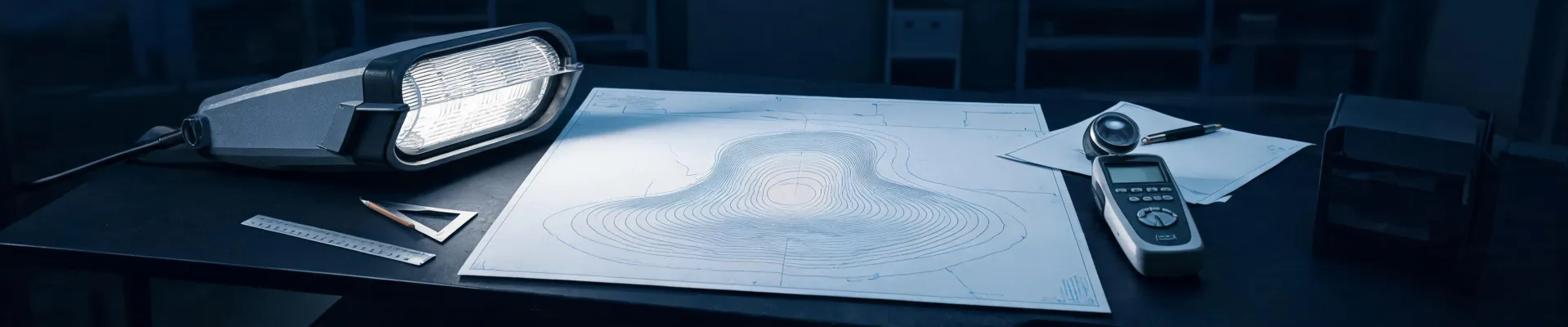
LM-79 is the standard for measuring total luminous flux, electrical power, and chromaticity of LED luminaires. I ask for a report from a lab following IES LM-79-19, ideally one that's ILAC-accredited. The report has to match the exact model I'm buying. I've seen test reports reused for a different housing or a different LED bin—the numbers don't hold.
Lifetime Data (LM-80 and TM-21)
An LED lifetime claim is only credible if it's based on LM-80 lumen depreciation data and a TM-21 projection. The TM-21 report shows useful lifetime at a given ambient temperature. If a manufacturer says 100,000 hours but can't show the report, treat it as a guess, not a specification. And if they claim “maintenance-free,” walk away. Every outdoor fixture will degrade eventually. The question is whether the rate is documented and predictable.
Color Consistency, Not Just CCT
This is the one most buyers miss. You can order 4000K from two different manufacturers, and both will be within the ANSI C78.377 chromaticity standard, but one can look noticeably green next to the other. For sports lighting, that means a patchwork field. I specify products that hold a 3-step MacAdam ellipse or better. It costs a little more, and it's worth it. This is one of those places where the “cheaper” fixture can end up being the most expensive, because you're paying to avoid a patchwork installation.
IP Rating and Test Certificates
IP66 means “dust-tight and protected against powerful water jets” only if the product was tested that way. IP ratings come from IEC 60529. I ask for the test certificate, not just the IP code in the catalog. It sounds bureaucratic, but I've seen an IP65-rated luminaire fail after one rainy season because the gasket wasn't seated properly during assembly. If you're planning to apply for utility rebates, check the DLC listing too.
Thermal Management: The Detail That Kills Cheap Fixtures
Here's the counterintuitive part: the same LED chip can last 50,000 hours in one fixture and 20,000 in another. The difference is not the LED. It's heat. A small heatsink and an under-specified driver will cook a good LED. If a manufacturer won't share thermal simulation data or driver derating curves, assume they don't have them.
In a sports lighting installation, this is even more important. The fixtures run at high power for hours at a time, often in hot climates. I look for manufacturers that can explain how the driver is derated at 40°C ambient. If the sales engineer can't answer that, the product isn't ready for my project.
Sports Lighting Sourcing: The Rule I Never Break
Sports lighting is unforgiving because failures are public. A flicker in a warehouse is annoying; a flicker on a field is a real problem. For sports lighting sourcing, I add one hard requirement: the photometric report must be from the exact configuration being installed—same LED count, same optics, same driver. I've seen a proposal use a 300W photometric file for a 500W fixture. It made the project look efficient until someone measured the light.
Delivery Certainty Is a Real Specification
Now let's talk about the thing that feels non-technical: lead time. I've never seen a lighting project fail because someone paid a little too much for a good fixture. I have seen projects fail because the cheaper vendor missed the ship date and the customer missed a season opening.
In May 2024, we paid a 12% premium for guaranteed lead time on a batch of flood lights. The difference was about $1,800 on a $15,000 order. The alternative was a vendor who said “around four to six weeks” with no penalty. We had a sports field opening in six weeks. The cheaper vendor probably would have been fine—but “probably” is not a schedule.
The premium wasn't for speed. It was for certainty.
The Mistake That Created Our Verification Checklist
In 2023, we received a production batch of “4000K” sports lighting fixtures that were actually running at 5000K. The sample had passed our quick photometric check. The production run didn't.
We didn't catch it until the first fixture was installed. The light looked cold and blue instead of the specified warm white. We had to re-lamp 24 units at our own labor cost. I still remember the project manager asking, “Didn't anyone check this?” The answer was yes—but not thoroughly enough.
The third time we ordered the wrong color temperature—or rather, the third time I had to explain it to a project manager—I finally implemented a mandatory two-round sample process. Round one: mechanical, electrical, and IP verification. Round two: photometric and chromaticity verification after a 100-hour burn-in. It adds about two weeks to the sourcing schedule, and it has cut our field failures dramatically.
What About Schreder Lighting?
People often ask me whether Schreder lighting is worth considering. I give the same answer I give for any manufacturer: ask for the documents that match the exact product you're buying. In my experience, Schreder outdoor lighting is more likely than most to provide LM-79, LM-80, and TM-21 reports quickly, because testing is built into their engineering culture. But I still verify. The best brands don't mind being checked.
If you're a distributor thinking about OEM or private-label supply, the checklist gets longer. You're not just buying fixtures—you're putting your name on them. Ask for the manufacturer's quality manual, inspection records from the last four production batches, and clear responsibility for warranty claims. If you're private-labeling, make sure the test reports can be updated with your brand name. Otherwise the first end-user complaint becomes your problem, not the factory's.
When This Framework Doesn't Apply
Let me be honest about the limits. This is a lot of process, and it's not necessary for every purchase.
If you need one replacement fixture for a parking lot tomorrow, a local distributor with a return policy is a better choice than a factory audit. The risk per unit is low, and the cost of verification is high.
This framework also doesn't tell you which brand is “best.” Schreder lighting makes excellent outdoor products, but another manufacturer might fit your region or project better. The goal isn't to pick a favorite brand. The goal is to know what a credible specification looks like.
And be careful with absolute promises. A manufacturer that guarantees “zero maintenance” or “100,000 hours under all conditions” isn't being confident—they're selling you a fantasy. Outdoor lighting wears down. The question is whether the wear is measured, documented, and predictable.

Clara Whitmore is a lighting photometry and LED source analyst specializing in bulbs, tubes, strips, panels, and integrated luminaires. She interprets IES LM-79 measurements and TM-30 color rendition data through luminous flux, efficacy, intensity distribution, CCT, chromaticity, fidelity, and gamut metrics. She writes evidence-led comparisons for specifiers selecting source formats and luminaires for commercial interiors, industrial spaces, or horticultural systems where measured optical and color performance matter.