-
Stop Comparing Unit Price. Start Comparing Total Cost of Ownership
-
Area Light Specifications Are the First Hidden Cost
-
Flood Light OEM vs Private Label: The Quote Covers the Box, Not the Risk
-
Energy and Maintenance Claims Need Evidence
-
But My Customer Only Cares About Price
-
Even Schreder Outdoor Lighting Gets the Same TCO Test
Here's my non-negotiable position: the cheapest flood light quote isn't a deal, it's a down payment on risk. I've spent four years as a quality and brand compliance manager at an outdoor lighting manufacturer. I review every specification sheet that reaches our distributors, roughly 200+ unique fixtures a year. In 2025, I rejected about 12% of first deliveries because of missing photometric reports, undocumented driver specs, or lifetime claims that didn't line up with the test data. That rejection rate isn't because suppliers are dishonest. It's because buyers are comparing the wrong number: unit price.
So let's talk about the number I actually use: total cost of ownership.
Stop Comparing Unit Price. Start Comparing Total Cost of Ownership
Unit price is the figure on the invoice. Total cost of ownership (TCO) is everything else: shipping, testing, rejects, rework, replacements, energy, maintenance, and the cost of a failure in the field. Time is also a cost. If a fixture has to be retested or reordered, the project timeline slips, and expedited shipping can wipe out a unit price advantage in one invoice.
I'm not a logistics expert, so I can't tell you how to optimize freight or container loading. What I can tell you from a quality perspective is that every unverified claim in a quote becomes your cost later.
In my first year sourcing area lights, I made the classic rookie mistake: I compared unit prices and picked the fixture with the highest lumens per dollar. It looked efficient. It wasn't. The spec sheet promised a wide distribution, but the photometric file showed something much narrower. The field installation failed to reach the required average light level, and the distributor had to add more poles. The redo cost more than the original purchase.
Area Light Specifications Are the First Hidden Cost
Every flood light quote has a spec sheet. The spec sheet is a summary, not a guarantee. I can't design your lighting layout; that's a lighting engineer's job. But I can tell you what I check before approving any product for distribution.
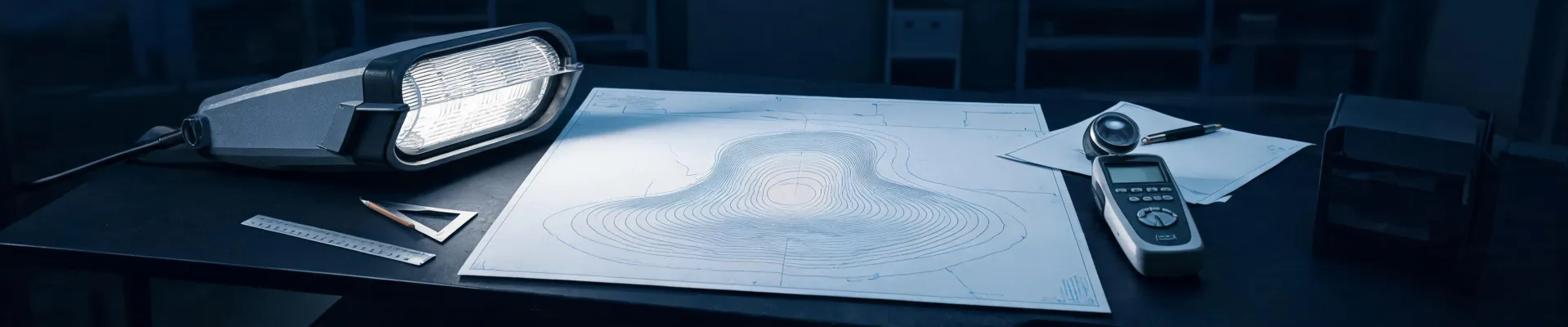
- Photometric data measured per IES LM-79-19, with an .ies or .ldt file from the actual product, not a generic curve.
- Lumen maintenance data per IES LM-80-15 and lifetime projection per TM-21-19. If you don't see a report, the lifetime number is a wish.
- IP rating per IEC 60529 and IK rating per IEC 62262, with test conditions. IP66 on paper is not IP66 in the field if the gasket design is marginal.
- Driver details: surge rating, input voltage range, operating temperature, and warranty. Driver failures are the leading cause of outdoor LED warranty claims.
- Compliance markings for your target market: UL 8750, CE, DLC, or the local equivalent.
Here's something vendors won't tell you: a spec sheet is a marketing document. The LM-79 report is the evidence. If the evidence isn't attached to the quote, you're not buying a product; you're buying a guess.
Flood Light OEM vs Private Label: The Quote Covers the Box, Not the Risk
Flood light OEM vs private label isn't just a manufacturing distinction. It's a risk allocation decision.
With an OEM arrangement, you're asking the manufacturer to build to your specification. You get engineering input, test data, and compliance support. The manufacturer is accountable for what they deliver. With private label, you're taking a product that already exists, attaching your brand, and then owning everything that happens after shipment.
Both models can work. But the unit price difference often reflects the difference in risk you're absorbing, not just the cost of materials.
If you're a flood light distributor, this can't be an afterthought. When you put your name on a fixture, your customer isn't calling the factory; they're calling you. If the product fails, your cost is the truck roll, the lost confidence, and the future projects you won't be invited to quote. That's TCO, even though it never appears on a purchase order.
What most people don't realize is that private label pricing can be lower for a reason. The quote doesn't include the warranty claims you'll manage, the compliance questions you'll answer, or the engineering hours you'll spend adapting a generic product to a specific application. That's not a rule, of course. There are serious private label manufacturers with strong quality programs. But I'd rather see a higher unit price with documented testing than a low price with a trust me spec sheet.
Energy and Maintenance Claims Need Evidence
Energy efficiency and lifetime are where TCO calculations go to die. They're also the easiest claims to fake.
If a spec sheet says 100,000 hours, ask to see the TM-21 report. TM-21 is an industry-standard method for projecting LED lumen maintenance based on LM-80 data. It gives you L70 and L90 values under defined conditions. Without that report, 100,000 hours is an adjective, not a specification.
High lumens per watt is also misleading if it's achieved only at 25 degrees C on a lab bench and not at real operating temperature in an enclosed area light housing. Look at thermal management, not just the LED chip. And check the warranty term. A fixture with a 50,000-hour L90 and a 5-year warranty is a completely different TCO than the same lifetime projection with a 2-year warranty.
But My Customer Only Cares About Price
I hear this objection constantly. A distributor says, 'My customer asks for the cheapest fixture, so I can't push a higher quote.' I understand that pressure. But I don't think it's true.
B2B buyers aren't asking for cheap. They're asking for a solution that doesn't make them look bad. When you quote a flood light based on unit price alone, you're handing your customer a problem they haven't discovered yet.
In our Q1 2024 quality audit, we reviewed 38 returned fixtures from a single warranty batch. Processing those claims cost more than three times the unit price difference between the low-bid fixture and the better alternative. That didn't include the customer's downtime or the damage to trust.
Caveat: I've worked primarily with mid-volume B2B distribution. If you're buying at container volume and can engineer around a certain failure rate, your TCO math may look different. I can't speak to that. But the principle remains: calculate TCO before you compare quotes.
Even Schreder Outdoor Lighting Gets the Same TCO Test
I use Schreder lighting and Schreder outdoor lighting as a reference because the range covers street lighting, sports lighting, wall lights, flood lights, and area lights. That breadth is valuable. But I don't approve a product because of the breadth of the line. I approve it because of the evidence in the file.
If you're evaluating Schreder outdoor lighting for a specific project, the questions are the same: What does the LM-79 report show? What's the TM-21 projection? What warranty comes with the driver? Who answers when the fixture fails? For a distributor, those questions are the TCO model.
Here's my bottom line: the flood light market is full of products that look identical on paper and perform very differently in the field. The distributor who wins is the one who wins the total cost argument, not the one with the lowest quote. Stop selling on unit price. Start selling on evidence. And if a vendor can't show you the evidence, walk away—because a down payment on risk is still a payment.

Clara Whitmore is a lighting photometry and LED source analyst specializing in bulbs, tubes, strips, panels, and integrated luminaires. She interprets IES LM-79 measurements and TM-30 color rendition data through luminous flux, efficacy, intensity distribution, CCT, chromaticity, fidelity, and gamut metrics. She writes evidence-led comparisons for specifiers selecting source formats and luminaires for commercial interiors, industrial spaces, or horticultural systems where measured optical and color performance matter.