The Email That Started It
The email landed at 4:27 PM on a Tuesday in March 2024. Subject line: 'Parking lot lights — is this fixed yet?' I hadn't even started. That pretty much sums up how I approached outdoor lighting procurement: too slow, too casual, and unable to spot the problem until it was already my name in an email chain.
I'm not an electrical engineer. I'm the office administrator who handles purchasing for a 180-person manufacturing company. Since I took over in 2020, I've processed somewhere between 60 and 80 orders a year across vendors for everything from office supplies to maintenance contracts. I report to operations and finance, which is a polite way of saying I catch the blame from both sides when something goes wrong.
In late February 2024, the VP asked me to get quotes for outdoor flood lights. The parking lot lights had been flickering for months, and two fixtures were completely dead. I did what anyone in my position would do: I searched for a flood light manufacturer, found four, and asked for pricing. I told every vendor the same thing: we need 24 outdoor LED flood lights, 4000K, for a parking lot and two building facades. I figured the rest was details. The details turned out to be the whole project.
What I Did Wrong
Without an electrical background, I focused on the obvious stuff: lumens, color temperature, unit price. Color temperature was the only spec I was confident about. I knew 4000K looked less orange than the old fixtures. I did not know that 'wet location listed' and 'UL traceability' were things to check. I didn't know what IES files were. The question I should have led with was: 'Can this fixture be legally installed on our property, with this electrical setup, in this municipality?' I didn't ask that. I didn't even know to ask it.
One manufacturer stood out because the quote was 32% lower than the others. They had a website with product photos and a downloadable brochure, but no detailed spec sheets. I called it a catalog. It wasn't. I ordered 24 fixtures. The sales rep mentioned something about compliance in the final email. I skimmed it and didn't follow up. (That sentence is going to follow me around forever.)
The Turn
The fixtures arrived five days later. Fast. Then the electrician came, looked at the first box, and asked to see the UL mark. I said, 'UL what?' He showed me the fixture. No UL listing. No wet location rating. No photometric data. He refused to install them until the inspector signed off on the paperwork. The inspector didn't sign off. The manufacturer's 'certificate' was a one-page PDF that looked nothing like the fixture we bought. (Which, honestly, I had to Google after the inspector left.)
After he refused, I called the vendor. The rep said, 'We have certificates.' They sent a PDF that looked like it was for a different product line, with a model number that didn't match. I emailed back asking for the correct one. No reply. Then the VP asked for a status update. Not a fun conversation.
I only believe in checking flood light compliance because I ignored it once and lost three weeks. The spring client event got pushed to a different space, finance asked why we ordered fixtures we couldn't install, and the VP asked if we'd used a real flood light manufacturer. The vendor's price was no longer 32% cheaper. It was just the opening line of a very expensive lesson.
Finding a Flood Light Manufacturer With a Real Catalog
After that, I called our usual electrical distributor and said I needed a flood light manufacturer who could provide actual documentation. They pointed me to Schreder. I'll be transparent: I'd always associated Schreder with street lighting, not parking lots. It turns out Schreder lighting is a much bigger category. Schreder outdoor lighting covers flood lights, wall lights, area lights, sports lighting, and street lighting. More importantly, their flood light catalog came with the paperwork I'd been missing.
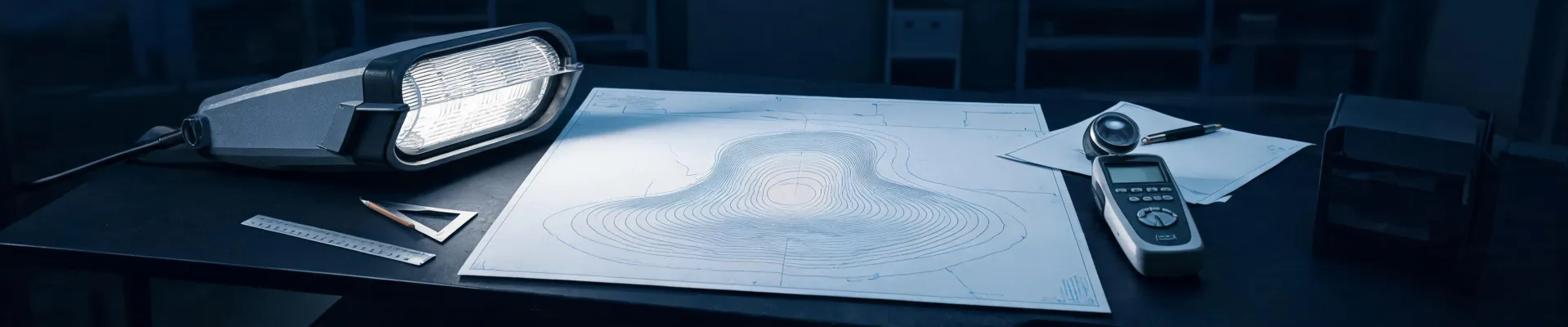
One of the distributor's people had worked on parking lot retrofits before. He asked about mounting heights, beam angles, and whether we needed cutoff optics to avoid glare. I hadn't thought about glare. That conversation alone changed what I looked for. Before Schreder, a catalog was a price list. The flood light catalog from Schreder is organized by application and performance. It includes photometric plots, mounting options, driver access, surge protection, and compliance data. When I requested files, I got them in a follow-up email without having to ask twice.
I also started reading claims more carefully. The original vendor's website said '70% energy savings' with no conditions, no test method, no caveats. Per FTC's advertising guidance (ftc.gov), performance claims need to be truthful and substantiated. If a flood light manufacturer can't produce evidence for its own numbers, that's a red flag I won't ignore anymore.
Flood Light Compliance Requirements I Check Now
Here's what I now call flood light compliance requirements. I'm not an inspector, so this isn't exhaustive. It's the list I use to screen manufacturers before I get attached to a price.
- Safety certification: a nationally recognized testing laboratory mark, usually UL, ETL, or CSA, that matches the exact model.
- Wet location rating: IP65 or better is what I look for on outdoor flood lights.
- Photometric data: IES files or at least a beam diagram, so the installer can prove the light will land where it should.
- Energy code data: documentation that helps the local authority having jurisdiction (AHJ) check compliance with codes like ASHRAE 90.1.
- Claim substantiation: any energy savings or lifespan claim that doesn't come with test conditions and evidence should be treated as marketing, not fact.
The Takeaway
We reordered from Schreder through the distributor. The fixtures arrived with clear labels, the electrician submitted the specs, and the inspection passed on the first attempt. The second install took nine days: one week for delivery, two days for installation and inspection. I'm not going to tell you Schreder is the cheapest option or that every project will run that smoothly. I don't have the data for that, and I don't make promises I can't substantiate. I can tell you the process was efficient because the documentation existed before the questions were asked.
I still have mixed feelings about how this ended. Part of me wants to believe every flood light manufacturer should have its paperwork in order. Another part knows the market is full of products that look fine in a photo and disappear under a spec sheet. My compromise now: start with a proper flood light catalog, ask for the compliance documentation first, and verify it before I share the price comparison with finance. The vendor who can't answer those questions? They're not a vendor. They're a detour. And I'm not gonna take that detour twice.

Clara Whitmore is a lighting photometry and LED source analyst specializing in bulbs, tubes, strips, panels, and integrated luminaires. She interprets IES LM-79 measurements and TM-30 color rendition data through luminous flux, efficacy, intensity distribution, CCT, chromaticity, fidelity, and gamut metrics. She writes evidence-led comparisons for specifiers selecting source formats and luminaires for commercial interiors, industrial spaces, or horticultural systems where measured optical and color performance matter.