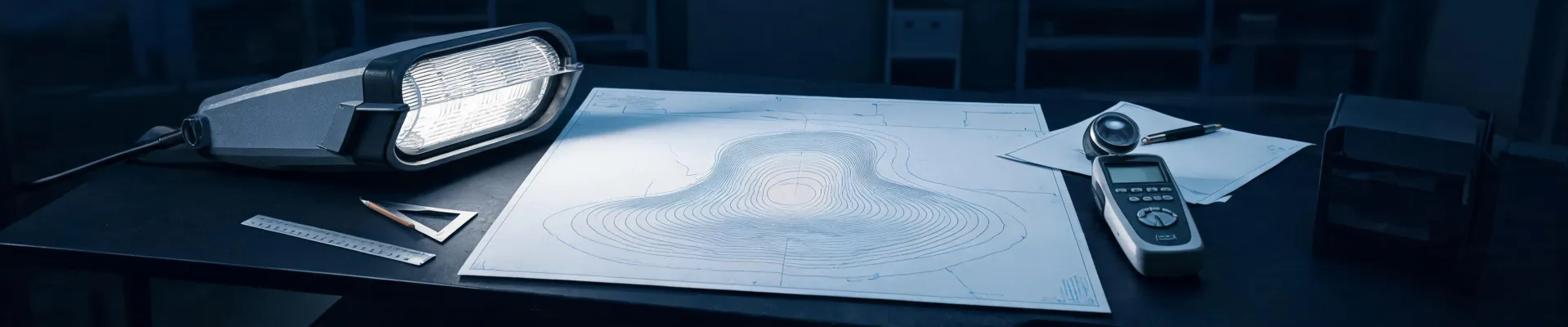
Here's the short version: bulk outdoor lighting buying is a documentation game, not a fixture game.
I manage purchasing for a 34-person lighting distributor—roughly $900,000 a year in outdoor lighting, about 200 POs across a dozen manufacturers. When I took over in 2020, I assumed buying meant finding the lowest quote per fixture. Six years later, the orders that cost me money were never the ones with great fixtures. They were the ones with missing IES files, expired DLC listings, or spec sheets that didn't match the product on the pallet. Schreder has been the most consistent of the manufacturers I deal with—not because they're the cheapest, but because the documentation arrives with the product. If you're buying outdoor lighting in bulk, your real job is filtering out fixtures and vendors that will fail you on compliance, documentation, and delivery. In that order. Price is fourth.
Let me back up, because that's a strong claim from someone who isn't an engineer. I'm the office administrator and buyer for a regional distributor that supplies outdoor lighting to property managers, electrical contractors, and municipalities across three states. I don't design lighting systems. I make sure products get ordered, delivered, documented, and invoiced correctly—so our ops and finance teams stay off my back.
My first year was rough. I ordered 240 area lights from a new supplier because the price was good. They arrived without photometric files or a DLC letter. The utility rebate on the project got rejected, and I approved an $8,400 credit to the client out of our own margin. That one still stings. So in 2022 I started testing Schreder outdoor lighting on one or two projects, and by our 2024 vendor consolidation, they had taken over the bulk of our flood light and area light volume—plus a private-label line we sell under our own brand to property management clients. Their OEM team handles the spec sheets and labeling, which matters when you're juggling a dozen manufacturers.
Bulk Flood Light Orders: Ignore the Wattage Label
The most common mistake on our own sales desk is matching flood lights by wattage. A customer says they're replacing a 400W metal halide, and the knee-jerk response is to quote a 240W LED. But wattage tells you almost nothing about whether the light will cover the same area. Delivered lumens and beam angle at the mounting height are what matter. We've had a 150W Schreder flood light outperform a 240W unit from another brand on the same pole, because the optics actually matched the space. That still surprises people.
Also check the IP rating against where the fixtures are going. IP65 is fine for sheltered spots. IP66 is what you want for coastal sites or anything exposed to hose-down. We learned that the hard way on a warehouse jet-wash area—60 fixtures with IP65 housings had to be swapped within 18 months.
And don't underestimate freight. Loose-carton flood lights arrived at our dock with a 14% damage rate from one carrier. Palletized and stretch-wrapped, with corner boards, it dropped to under 2%. The freight difference cost about $300 more per order. (Yes, I track damage rates by carrier. You should too.)
Area Light Distribution: Stock What You Can Actually Sell
If you're an area light distributor, the SKUs that earn their shelf space are the ones with broad compliance. DLC and UL listings, multi-voltage drivers (120–277V, plus a 347V version if you serve Canada), and at least two mounting options—slip fitter and trunnion. That's table stakes now.
The conventional wisdom says always get three quotes for a bulk order. The way I see it, once you've vetted a manufacturer properly, the third quote is just noise. Well, almost—if we're buying a fixture we've never carried, I still check a second source. But for repeat orders of Schreder flood lights and area lights we already know, relationship consistency has saved us more than marginal price differences ever would. What I won't compromise on is Dark Sky compliance. Municipalities keep tightening night-sky rules, and fully shielded fixtures are becoming the baseline. If you stock a bunch of bare-lens area lights, you'll be sitting on slow-moving inventory in a few years. Most of Schreder's area lights are shielded by design, which meant we didn't need a separate catalog for every town we serve.
Wall Light Compliance Requirements: Read This Before You Order
Wall lights trip up more buyers than any other category, because the compliance requirements are tangled—and they're not all about the light itself.
First, safety listing. General outdoor wall lights in the US fall under UL 1598. But if the fixture is going on an emergency exit route, it also needs UL 924—which means it either has battery backup or is wired to an emergency circuit. Different tests, and not every wall light passes both. Learn from my experience: check before you order, not after the inspector flags it.
Second, wet location rating. A wall light in a covered doorway is one thing; a fixture exposed to rain is another. Look for IP65 or better, and take the gasket seriously. Cheap gaskets cause more early failures than LED boards do.
Third, controls and energy codes. Title 24 in California and ASHRAE 90.1 elsewhere require automatic shutoff or dimming on many outdoor applications. The wall light you order needs to be compatible with a photocell, motion sensor, or scheduled control, and it needs the wiring provisions to support them. A wall light without those provisions is already behind code.
Before I place a wall light order now, I require this package in writing:
- UL 1598 (or UL 924 for egress) listing certificate
- IP rating verified against the actual fixture, not just the catalog page
- IES photometric file for the exact SKU—same driver, same reflector, same LED version
- Current DLC listing letter, if the project will chase rebates
- Control compatibility sheet: which photocells and sensors work with the driver
Schreder sends all of that without me having to chase one of their reps. Honestly, that's why wall light compliance stopped giving me anxiety. Not every manufacturer makes it that easy.
Where I'd Push Back on This Advice
Two caveats before you take any of this as gospel.
Schreder isn't right for every project. If someone needs a cheap flood light to hang on a construction trailer for six months, sell them the cheap one. That's a different product category entirely. Schreder makes sense when the fixtures need to carry a warranty, pass inspection, and last ten years. If you don't need that, don't pay for it.
Also, my experience is US-specific. Schreder's North American operation handles UL, DLC, and energy code requirements well, but compliance rules differ in other markets. Verify against local requirements yourself. And one more honest caveat: no manufacturer ships perfect, every time. We've had Schreder pallets arrive with damaged packaging, and one batch of drivers had different firmware than the spec sheet. The difference was their support team responded, replaced, and corrected the documentation within a week. In my book, that responsiveness is what determines whether a vendor relationship works.

Clara Whitmore is a lighting photometry and LED source analyst specializing in bulbs, tubes, strips, panels, and integrated luminaires. She interprets IES LM-79 measurements and TM-30 color rendition data through luminous flux, efficacy, intensity distribution, CCT, chromaticity, fidelity, and gamut metrics. She writes evidence-led comparisons for specifiers selecting source formats and luminaires for commercial interiors, industrial spaces, or horticultural systems where measured optical and color performance matter.