-
Step 1: Describe the lighting task — not the wattage
-
Step 2: Match the product family and mounting details
-
Step 3: Request and verify photometric files
-
Step 4: Confirm electrical specs, controls, and surge protection
-
Step 5: Verify compliance and certifications
-
Step 6: Lock down lead time, quantities, and delivery terms
- Common mistakes I see on rush orders
-
The final checklist
If you're here, you're probably looking for a street lighting specification guide — or you need to order bulk flood light fixtures for a project with a deadline that's already tight. I'm a fulfillment coordinator at Schreder, an outdoor lighting manufacturer that ships to distributors, wholesalers, and OEM/private label buyers across multiple regions. In the last two years, I've processed over 200 bulk and rush orders. Most of those emergency calls were caused by specification gaps on the buyer's side — not by the fixtures.
So this is the checklist I run through with every buyer. Use it if:
- You're a distributor or wholesaler quoting a project that uses Schreder outdoor lighting.
- You're buying bulk flood light fixtures and need to get the order right the first time.
- You're an OEM/private label buyer who needs compliant fixtures without a 10-week back-and-forth.
This doesn't cover custom photometric modeling for huge infrastructure corridors. That's a deeper process. But for typical distributor quotes, Schreder lighting projects, and bulk flood light purchases, these six steps handle most of the risk.
Step 1: Describe the lighting task — not the wattage
The most common issue on purchase orders that cross my desk: "250W flood light." That's a wattage, not a specification. What are you lighting? A football pitch, a car park, a roadway, a building facade? The answer changes everything.
Why does this matter? Because the photometric design determines the fixture count long before the wattage matters. A 250W flood light with a narrow beam is a completely different product from a 250W flood light with a wide asymmetric distribution.
Before you send the RFQ, know these:
- The area to be lit — footprint dimensions, mounting height, surface type.
- The target lighting level — lux or foot-candles, plus uniformity requirements.
- Restrictions — spill light, glare, dark sky requirements, uplight limits.
Step 2: Match the product family and mounting details
Once the task is defined, the right product family becomes easier to identify. Street applications typically need road-approved optics. Sports areas need bulk flood lights with sealed optical units and precise beam options. Facades and architectural spaces need wall lights with controlled distributions.
This is where details matter: pole top diameter, bolt hole pattern, arm length, tilt angle, junction box location. I've had orders delayed because the mounting bracket didn't fit the pole — and the buyer didn't open the dimension drawing until the fixtures arrived on site.
Look, I'm not saying you need to be a mechanical engineer. But checking the dimensional drawing before ordering can save you a reorder that costs twice as much as the original fixture.
Step 3: Request and verify photometric files
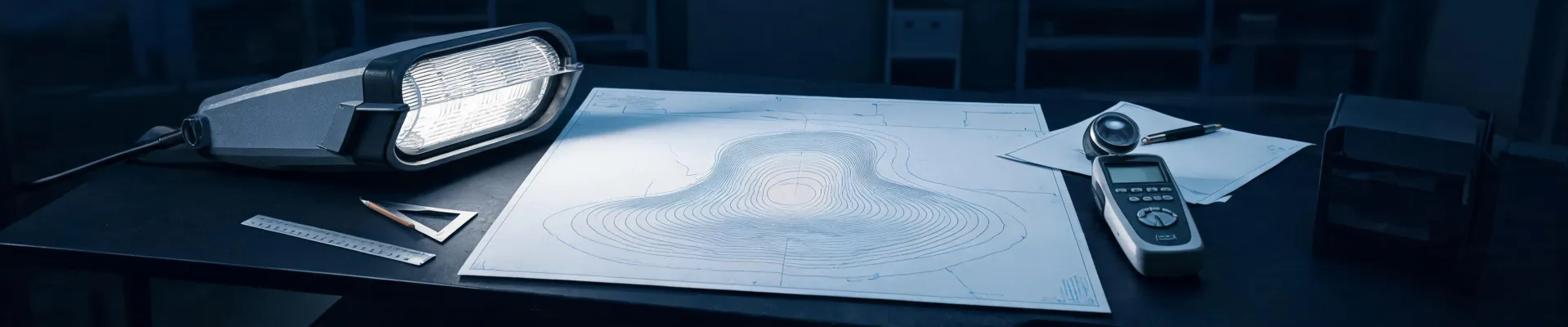
Here's something vendors won't tell you: the housing is not the spec. Two fixtures can look identical on the outside, while one has a Type II street distribution and the other has a narrow flood beam.
For any Schreder lighting project, ask for the .ies or .ldt photometric file. If you're designing a street layout, you'll need these files in your lighting software anyway. If a supplier can't provide photometric data, that's a red flag — it means the fixture was never properly tested.
What most people don't realize is that the photometric file is the project's budget in disguise. A poorly matched distribution means more poles, more wiring, more installation labor — and the fixture cost becomes irrelevant.
Step 4: Confirm electrical specs, controls, and surge protection
This is the least glamorous step, and it causes the most emergency reorders.
Check these before you request a quote:
- Input voltage — 120V, 208V, 240V, 277V, or 230V for other regions.
- Photocell / dusk-to-dawn sensor requirement.
- Dimming, staged brightness, or smart control protocols.
- Surge protection level for the site's risk environment.
Here's the thing: on my 200+ orders, the wrong-voltage call is the most common emergency. A buyer selects a fixture based on wattage, and nobody on the chain confirms the project voltage until the first fixture is already up.
Step 5: Verify compliance and certifications
Depending on your market, you may need:
- DLC listing for utility rebates (USA/Canada).
- UL/cUL certification.
- IP rating for water ingress and IK rating for impact resistance.
- Photometric test reports per IES LM-79 and LM-80.
Certification isn't static. Five years ago, a DLC listing was a nice-to-have; today it's a de facto requirement for many utility rebate programs. The fundamentals haven't changed — you still need the right light in the right place — but the compliance landscape has transformed. According to the IES (ies.org), luminaire photometric testing should follow IES LM-79-19 for electrical and photometric measurements of solid-state lighting, and LM-80-20 for LED lumen depreciation. If your project depends on rebates, verify the current DLC Qualified Products List at dlcqpl.org. A product that was listed in 2023 might not be listed today.
Step 6: Lock down lead time, quantities, and delivery terms
Now the part I know best.
For a bulk flood light order — especially from an outdoor lighting manufacturer shipping across borders — the fixture price is only one number. Before you commit, get written confirmation of:
- Production slot, not an "estimated ready date."
- Shipping method — sea, air, or truck; container or LCL.
- Incoterms, customs responsibility, and port of entry.
- Partial delivery options if the site needs staged installation.
The value of a confirmed lead time isn't the speed. It's the certainty. For a construction or event deadline, knowing the order will arrive on the specified date is often worth more than saving 3% on the fixture price. Total cost of ownership includes the base product, freight, customs fees, potential air freight, and the cost of a late arrival. I've seen buyers choose a slightly cheaper fixture and lose the difference in one emergency shipping invoice.
In March 2024, I had a distributor call me at 4 PM on a Thursday. They'd won a sports field project and then found out their original supplier couldn't deliver 60 bulk flood lights in time. Missing the site deadline would have triggered a $50,000 penalty clause. We confirmed we could produce and ship the full order within three weeks; air freight added $2,300 to their invoice. The lights landed with five days to spare. Their alternative was losing a $180,000 contract.
Common mistakes I see on rush orders
1. Ordering before the photometric layout is finished
I get it — you want to lock in a price. But if the distribution is wrong, the price doesn't matter. The reorder costs more in time and freight than any early discount you'll get.
2. Ignoring the dimension drawing
Last year, a buyer ordered 120 street lighting fixtures and didn't check the arm bolt pattern until they were at the job site. They lost three installation days and paid for orphaned brackets. The drawing was available at the quoting stage.
3. Treating "equivalent to" as a spec
Last week, a buyer told me they needed a fixture "equivalent to" the one from their previous project. I had to stop them there. In lighting, there's no such thing as equivalent. The optics, drivers, certifications, and mounting pattern are specific to the actual part number. If you're an OEM/private label buyer, the exact part numbers should be on your PO.
The final checklist
- Define the lighting task: area dimensions, target lux, beam type, restrictions.
- Select the product family and confirm mounting details.
- Request and verify the .ies/.ldt photometric files.
- Confirm voltage, controls, and surge protection.
- Check certifications and compliance documents.
- Confirm lead time and delivery terms in writing.
Last thing: my experience here is based on about 200 mid-size to large orders, mostly for distributors and contractors on commercial and municipal projects. If you're working on a 5,000-fixture infrastructure corridor, your process will need deeper photometric modeling and more rigorous compliance review. But for typical bulk orders, this checklist handles the risk that actually causes emergencies.

Clara Whitmore is a lighting photometry and LED source analyst specializing in bulbs, tubes, strips, panels, and integrated luminaires. She interprets IES LM-79 measurements and TM-30 color rendition data through luminous flux, efficacy, intensity distribution, CCT, chromaticity, fidelity, and gamut metrics. She writes evidence-led comparisons for specifiers selecting source formats and luminaires for commercial interiors, industrial spaces, or horticultural systems where measured optical and color performance matter.