When I first started sourcing outdoor lighting for distributors, I assumed OEM and private label were basically the same thing—same factory, same LED chips, just a different logo on the housing. Seven years as a procurement specialist handling outdoor lighting orders taught me otherwise. I've made and documented four significant mistakes, totaling roughly $62,000 in wasted budget. This article is me trying to save you from repeating any of them.
If you're deciding between OEM and private label for a bulk flood light order, a sports lighting project, or a Schreder outdoor lighting purchase, here are the four dimensions I compare:
- Specification control
- Cost structure and MOQs
- Lead time and coordination
- Compliance and brand ownership
One of these conclusions surprised me when I landed on it. It might surprise you too.
Dimension 1: Specification Control
OEM means you own the specifications. You define the photometric requirements, IP rating, housing material, driver specs, surge protection levels. The manufacturer builds to your numbers.
Private label means you choose from existing designs. You pick housing color and add your brand, but the optics and performance characteristics are whatever the factory already offers.
I learned the difference the hard way on a sports lighting project in 2022. I ordered 200 bulk flood lights on a private label model, assuming the lux levels would work for the client's multi-purpose court. I didn't check the photometric files. (Honest answer: I didn't even know I was supposed to.)
The lights went up. The client measured illuminance. It came in at 60% of the minimum average lux for recreational play. 200 fixtures, $28,000, all needing replacement.
Not great. Not terrible. Just wrong.
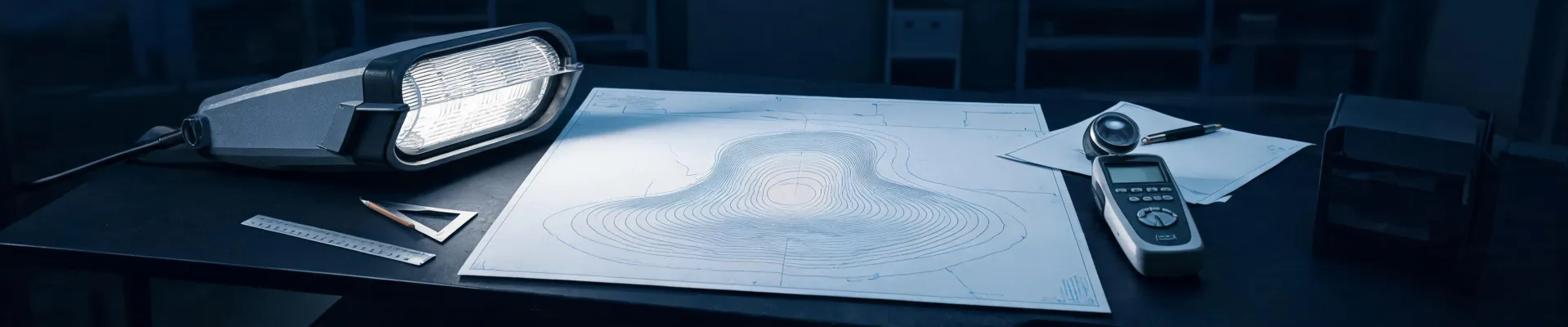
That's when I learned about IES LM-79 test reports and .ies photometric files. Every serious outdoor lighting manufacturer publishes them—Schreder included. Load them into AGi32 or Dialux and you'll see exactly how light distributes on the surface, before you spend a dollar.
This matters even more with sports lighting specifications. IES recommends around 300 lux average for recreational tennis, 500 or more for club-level play, and 750+ for professional competition. And that's only the illuminance side. You also have glare ratings (UGR), light spill limits, and uniformity targets. A private label fixture that works fine for a parking lot can be nowhere close to a sports spec.
My conclusion: if your project has strict performance requirements, OEM gives you control that private label cannot match. Optics, lumen output, CCT, beam angles—all adjustable. Not every manufacturer offers this, but the ones that genuinely support OEM will.
Dimension 2: Cost Structure and MOQs
Here's where my initial assumptions were dead wrong. I thought OEM would always be more expensive. Turns out, it depends entirely on quantity.
Private label has a lower entry barrier—smaller MOQs, no engineering fees, no prototyping. If you're ordering 100 to 500 units, private label will almost certainly be cheaper.
At scale, the math flips. OEM unit costs become negotiable past certain quantity thresholds. Tooling amortization, material procurement, production scheduling—all get more efficient. I've seen OEM quotes beat private label pricing by 10-15% on orders above 2,000 units, while delivering features private label didn't even offer, like custom surge protection or extended driver warranties.
And there's a hidden cost side too.
I once ordered 1,500 private label flood lights because the quote was 15% below the OEM alternative. The spec sheet claimed "10kV surge protection." It sounded impressive. What I didn't catch: the protection only covered the neutral line, not the live line. On a coastal project with frequent thunderstorms, 12% of the units failed within 14 months.
Technically accurate. Practically misleading.
The replacement cost wiped out the 15% savings, and then some.
My rule now: if an order exceeds $20,000, I require documented test evidence. LM-80 for LED chip longevity, TM-21 for lumen maintenance projections, plus the relevant certification records. If a manufacturer can't produce those, "cheaper" is just a slow way to spend more.
Dimension 3: Lead Time and Coordination
Private label wins on speed. Catalog SKU, sample approval, production schedule. Predictable. Efficient. Boring—in the best way.
OEM is slower. Spec reviews, sample approvals, possible tooling adjustments. My first OEM sports lighting order took 16 weeks from PO to shipment. A comparable private label order? 9 weeks.
The most frustrating part: the OEM order got delayed because a custom driver had a 3-week raw material shortage. I couldn't swap components because the whole design was built around that part. Stuck.
Did I trust the initial lead time estimate? Yes. Was that a mistake? Absolutely. (Note to self: manufacturer lead times are minimum times, not actual times.)
Here's the counter-intuitive bit. OEM lead times get more reliable with each repeat order. By our third OEM project with the same factory, we had material schedules and reserved production slots. That order shipped in 10 weeks—faster than my first private label order ever did.
The question isn't which option is faster. It's which one you can predict.
Dimension 4: Compliance and Brand Ownership
This is the dimension most buyers underestimate.
With private label, the manufacturer owns the compliance story. They hold the UL/cUL listings, the photometric test reports, and the core design liability. You're putting your brand on their product, and if a compliance issue surfaces, you're both in it.
With OEM, you own the specification. So you also own the consequences of getting it wrong. The manufacturer builds to your numbers. If your specs have an issue—like a driver that derates badly in high ambient temperatures—the responsibility lands on you.
My 2022 football field project is a case study. The sports lighting specifications came from the client's engineering consultant. The lux calculations were done by a professional lighting designer. Everything looked solid.
Except no one verified mounting height against the photometric design.
The poles installed 2 meters lower than the design software assumed. Center of the field was over-bright. Uniformity ratio failed the spec. Consultant rejected the installation. Re-aiming 32 fixtures and adjusting pole heights cost $6,200 in labor plus a 2-week delay. (Ugh.)
The equipment was fine. The installation was wrong. Compliance isn't only about certifications—it's about the gap between certified performance and installed performance.
My pre-production checklist now includes mounting height verification on every engineered lighting project. No production start until the installer confirms the dimensions match the design assumptions.
The Surprising Conclusion
After all that, you'd think I'd say "OEM is always better." I don't believe that anymore.
The real lesson: the worst OEM failures I've seen came from buyers who never truly engineered their specifications. You can't tell a manufacturer to "just make it better" and expect magic. OEM demands you show up with data.
Private label isn't the lazy option I once dismissed it as. A well-chosen private label product backed by solid photometric data and certification records can handle demanding projects just fine.
The real difference comes down to one question: who owns the spec, and are they prepared to own the risk?
A 5-Point Pre-Purchase Checklist
I created this checklist after my third significant mistake in Q2 2022. In the last 18 months, it's caught 47 potential order errors and saved roughly $38,000 in what would have been rework and replacement.
- Load the photometric file before you approve anything. No .ies file? Walk away.
- Verify mounting height assumptions against your actual installation plan. This is where the most expensive mistakes hide.
- Ask for LM-80 and TM-21 reports. If they can't produce them, you don't actually know how long the product will last.
- Confirm compliance listings cover the exact configuration you're buying. Configurations change; listings don't always keep up.
- Match the IP rating to your site conditions. Coastal, dusty, high-humidity—each changes the right choice.
Five minutes of verification beats five weeks of correction. That isn't marketing talk. It's the lesson from a $28,000 mistake I was too embarrassed to discuss for years.
So Which Should You Choose?
It depends on your business model and what you're promising your customers.
If you're buying bulk flood lights for a distribution channel that values competitive pricing and reliable availability, private label is a legitimate strategy. Schreder lighting offers a range of outdoor products designed for private label branding—product depth without the engineering overhead.
If you're supplying sports complexes, municipal infrastructure, or other projects with engineered lighting designs, OEM gives you the control and the compliance trail to back your promises.
The smartest approach—and the one I wish I'd taken from day one—is finding a manufacturer that supports both paths. Schreder outdoor lighting can be sourced through OEM for fully custom projects or private label for standard orders. When a project needs custom optics or specific sports lighting specifications, OEM is there. When it's a straightforward order, private label keeps margins healthy.
Having that flexibility made my job far easier than it was in year one. Whichever route you pick, the rule underneath never changes: prevention over cure. Verify before you commit. The product you approve on paper is the product you'll live with in the field.

Clara Whitmore is a lighting photometry and LED source analyst specializing in bulbs, tubes, strips, panels, and integrated luminaires. She interprets IES LM-79 measurements and TM-30 color rendition data through luminous flux, efficacy, intensity distribution, CCT, chromaticity, fidelity, and gamut metrics. She writes evidence-led comparisons for specifiers selecting source formats and luminaires for commercial interiors, industrial spaces, or horticultural systems where measured optical and color performance matter.