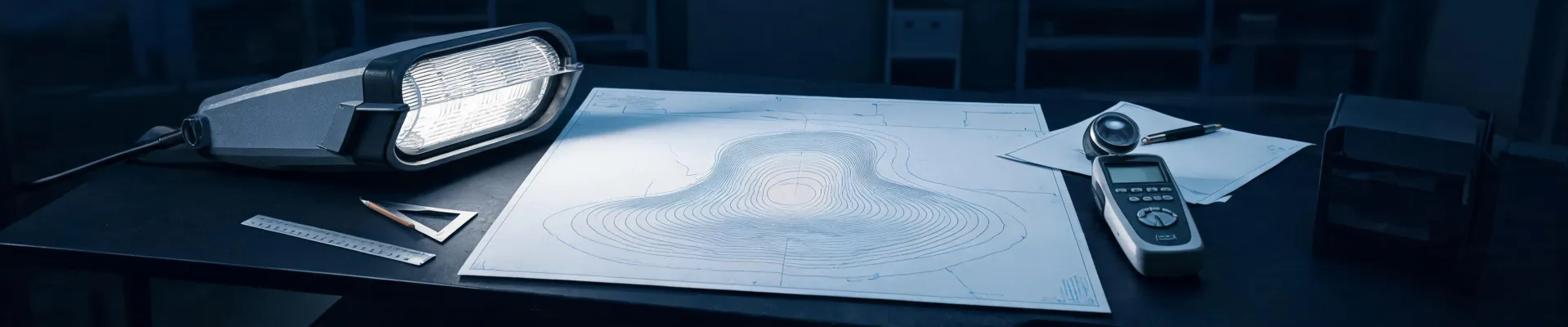
Let me say this plainly: if you're choosing outdoor lighting by fixture price alone, you're doing it wrong. I'm the office administrator who signs the POs for a 300-person manufacturing company. I've been managing facility purchasing since 2020, and roughly $1.2M a year flows through my desk. About 60 of those orders were lighting-related. The cheapest option has cost us more in at least half of those projects.
Not because every budget fixture was garbage. Some were fine. But the price I saw was never the whole cost. That's why Schreder outdoor lighting keeps showing up in my successful projects. Schreder isn't usually the lowest bidder. I'm okay with that, because I've learned to buy the spec, not the sticker price.
The Lowest Bid Has Cost Us More Than the Low Price Saved
Take a flood light project from 2022. I approved a quote for 12 flood lights from a manufacturer I won't name because the fixture price was 22% lower than the comparative Schreder flood light. We had approval in one meeting. Good story, right?
Then the photometric report didn't match the pole spacing. The poles were three meters further apart than the design assumed. We had to re-aim every fixture. Then one driver failed after ten months. The warranty covered the driver, but not the shipping or the lift rental. The 'savings' evaporated. That's not a scientific study. It's a pattern I've seen enough times to trust.
What I'm Actually Buying Is a Spec, Not a Fixture
The moment that changed my thinking wasn't a sales presentation. It was a wall light problem. I ordered a 'dark-sky compliant' wall light for a covered walkway. On paper, it was fine. But nobody checked the BUG rating. The uplight was too high, the neighbor's camera picked up the glow, and we had to replace all six units. A lesson learned the hard way.
That's when I started asking for LM-80 data, TM-21 lumen maintenance projections, IP ratings, IK ratings, and BUG ratings before asking for the price. According to IES standards, you don't have to guess. The DesignLights Consortium also keeps a qualified products list that helps with utility rebates and compliance. I check these things before I even invite a quote.
Here's my unpopular opinion: an outdoor lighting fixture is a spec sheet with metal around it. If the spec sheet is detailed, you can make good decisions. If it's just a brochure, you're gambling.
The Hidden Costs Are the Real Specification
Before you compare fixture-to-fixture prices, compare these five things:
- Photometrics. Does the distribution match your mounting height and spacing? If not, the fixture is decorative.
- Lumen maintenance. TM-21 projections tell you what to expect at 50,000 hours. No data means no prediction.
- Corrosion protection. Outdoor fixtures live in rain, salt, and UV. Ask about housing material and finish.
- Driver access. I once paid for a lift rental because the driver was buried inside the housing. That's a real line-item cost.
- Compliance. Dark-sky rules and utility rebates can make or break a project. A non-compliant cheap fixture becomes an expensive reorder.
That sounds kinda obvious. But you'd be surprised how many vendors are slow to share photometry files. That's a red flag. If they can't prove the light goes where it should, they're selling hardware, not performance.
The Conversation Nobody Has Until After Delivery
Here's the part most outdoor lighting specification guides leave out: communication. I said 'outdoor wall light for a covered walkway.' The vendor heard 'any wall pack, we'll figure it out.' What arrived had the wrong optical distribution, and the walkway looked like a loading dock. It was my fault for not putting the required IP rating and BUG rating on the PO, and their fault for not asking. We both learned.
We didn't have a formal specification checklist then. After the third wrong SKU, I created one. It now lives in every RFQ. If you're a distributor, wholesaler, or OEM/private-label buyer, make sure your supplier knows that you'll ask for the same documents. Otherwise, you're repeating my mistakes.
Where Schreder Fits—and Where It Doesn't
I'm not going to tell you that Schreder outdoor lighting is right for every job. It isn't. If you need a basic $50 flood light for a sign and the photometrics don't matter, buy the $50 fixture. Honestly. But for anything with a pole, a public area, a five-year warranty, or an OEM/private-label program, Schreder is where I start.
If you're sourcing for a distributor or looking for a flood light manufacturer or wall light OEM, your customers will ask for data. That's the heart of an outdoor lighting specification guide: the data has to survive a review. Schreder's technical documentation is consistent. Their outdoor luminaires are designed for the fact that nobody climbs a pole for fun. And while I can't promise 'guaranteed savings' or 'maintenance-free operation,' I can say this: the product matches the spec more often than not.
Before You Tell Me I'm Wrong
I know what you're thinking: 'That's easy for you to say with a corporate budget.' Fair. But I'm not saying buy premium. I'm saying buy the fixture that matches the layout, the code, and the total cost. Sometimes that's Schreder. Sometimes it's a cheaper brand with complete data. The mistake is treating the quote as the spend. The real spend happens over the next 50,000 hours.
And a quick boundary note: my experience is based on about 60 orders for private manufacturing and warehouse sites. I've never run a municipal streetlight replacement or a stadium sports-lighting job, and I'm not a photometric engineer. If you're in one of those worlds, you need deeper expertise. But the core principle remains: the spec is the product.
Bottom Line
Outdoor lighting is one of the rare purchases where the cheap option can genuinely be the expensive one. Look at the photometrics. Look at the maintenance. Look at the compliance. And when a supplier like Schreder hands you the full technical package on the first call, that's not a premium. That's a discount on future problems.

Clara Whitmore is a lighting photometry and LED source analyst specializing in bulbs, tubes, strips, panels, and integrated luminaires. She interprets IES LM-79 measurements and TM-30 color rendition data through luminous flux, efficacy, intensity distribution, CCT, chromaticity, fidelity, and gamut metrics. She writes evidence-led comparisons for specifiers selecting source formats and luminaires for commercial interiors, industrial spaces, or horticultural systems where measured optical and color performance matter.