The short answer
If you are qualifying a supplier for bulk outdoor lighting — flood lights, area lights, street heads — three documents tell you whether they are a real manufacturer or a trading desk with a good PDF: an LM-79 test report from an accredited lab, IP and IK ratings backed by an actual test report number, and warranty terms that name who pays for removal and reinstallation. Price per unit is the fourth question, not the first.
If a flood light distributor cannot send you an LM-79 report and the IES photometric file within 24 hours of asking, they are almost certainly reselling someone else's product and repeating someone else's spec sheet. That is not automatically disqualifying — but it changes how you negotiate, how you hold inventory, and how exposed you are when a job goes sideways.
Why I have a strong opinion about this
I've been handling bulk outdoor lighting orders for a distributor for about nine years — street lighting, sports lighting, wall lights, flood lights, area lights. We've placed somewhere around 200 bulk orders. Maybe 180, I'd have to check the system. I've personally made and documented enough mistakes to fund a small parking lot, and the total damage is somewhere in the $30,000 range if I'm being honest about it.
The one that still bothers me happened in September 2022. We placed a 60-piece flood light order for a sports court retrofit. The supplier's sheet said "150W, equivalent to 400W metal halide." Looked fine. The quote was about 35% below the next option, and the client was under budget pressure, so I approved it.
There was no LM-79 report. There was no IES file. I asked for photometrics and got a screenshot of a lux meter taken on a factory floor.
We installed the fixtures. The client came back two weeks later with a light meter app and photos. Roughly 40% below the claimed output, and a hard glare band across the far baseline. We replaced 34 of the 60 units out of our own pocket. That error cost about $3,200 in fixtures, around $900 in lift rental and labor, and a client relationship I'm still repairing. The cheaper quote was not cheaper.
"Equivalent to X" is shorthand that gets repeated in this industry because it is simple to say and nobody makes you prove it. A test report is the only version of that claim that survives contact with a customer who owns a light meter.
Document 1: Photometric data, not wattage equivalence
There are three acronyms worth knowing, and you do not need to be a lighting engineer to use them.
LM-79 is the IES-approved method for measuring a complete, finished luminaire — total lumens, efficacy, color temperature, color rendering, and the distribution pattern, all measured as one assembly rather than by adding up component specs. LM-80 covers the LED package itself, and TM-21 is the projection method for estimating lumen maintenance past the LM-80 test window. When a supplier promises "50,000 hours," TM-21 is (or should be) the source of that number.
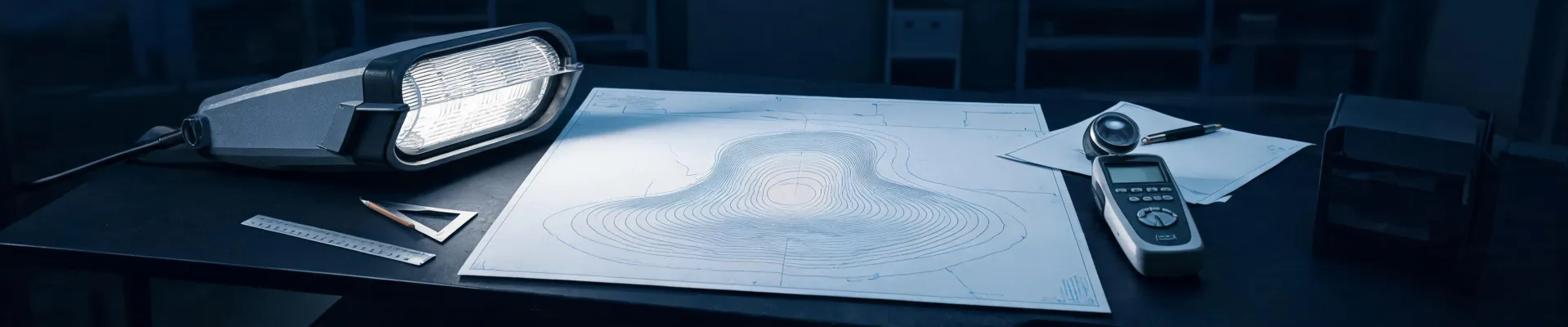
The practical filter is simpler than the theory: ask for the IES file. An IES file is what lets your designer drop the fixture into DIALux or AGi32 and actually see whether the court, the lot, or the roadway meets spec at the mounting height you have. A supplier who provides IES files for the whole range is a supplier who expects to be modeled. A supplier who only provides a lux screenshot is hoping you won't be.
I use Schreder outdoor lighting as my reference point here, not because their numbers are automatically right for every job, but because they publish complete photometric files for essentially the full range. That is what "complete" looks like. When I'm grading a new flood light distributor, I compare their document pack to that baseline. If half the range has no IES file, I know what kind of relationship I'm getting into.
Document 2: IP and IK ratings with a report behind them
"IP66" on a spec sheet is a marketing line until you can see the test report. The rating itself is defined by IEC 60529 for ingress protection, and the impact resistance rating (IK) is defined by IEC 62262. Both are testable, both are documented, and both are routinely copied from a similar product onto a different one.
What this costs when it goes wrong: we had a batch of flood lights marked IP65 on a coastal installation (this was back in 2022). The gasket was glued into the housing channel rather than molded as a continuous seal. Four months in, we had condensation in 11 of 22 units and visible corrosion on the driver compartment. The supplier's position was that the rating was correct and the installation environment was unusually aggressive. That is a very expensive conversation to have with a client who lives two blocks from the ocean.
For pole-mounted roadway and area products, also ask about vibration testing. The ANSI C136 series covers roadway and area lighting equipment, and C136.31 addresses luminaire vibration — relevant if your fixtures are going on tall poles or in wind-exposed locations. A fixture that survives shipment is not automatically a fixture that survives ten years on a pole.
I'm not 100% sure every utility rebate program still requires it, but DLC listing has been the gate for utility incentives on commercial outdoor lighting for years. If your client expects a rebate, that is worth confirming before you order rather than after. (DLC is the DesignLights Consortium — they maintain the qualified products list utilities draw from.)
Document 3: Warranty wording, which almost nobody reads
A ten-year warranty sounds like ten years of coverage. Read the exclusions and it often turns into a parts-only replacement with the buyer paying freight both ways, plus a clause requiring installation by a licensed electrician with documented torque values, and a separate short or nonexistent term on the LED driver.
Typical warranty exclusion language: "This warranty covers the luminaire housing and LED board only. Labor, removal, reinstallation, freight, and consequential damages are excluded. Driver warranty is limited to three years."
That is the clause that decides whether your total cost of ownership is defensible. Since the driver is the most common failure point in an LED luminaire, a ten-year housing warranty paired with a three-year driver warranty is effectively a three-year warranty with extra paperwork.
Worth mentioning here: per FTC guidance on advertising claims, statements like specific lifespans or energy savings need substantiation behind them. When a supplier puts a number in a brochure and can't produce the test method, they're not just being vague — they're putting the risk on you. Granted, nobody audits a supplier's brochure. But the same gap in rigor shows up later in the warranty discussion, and that one you can't ignore.
The math that actually decides it
Here is the version of the calculation I use. On a 200-piece flood light order, a $28 fixture versus a $46 fixture is $3,600 in apparent savings. That looks like a real win on the PO.
Then one localized failure cluster — say 40 units — costs you a lift rental, an electrician for two days, freight, and the replacement units. In our case that came to about $4,100, plus a three-week schedule slip. The $3,600 evaporated and left a deficit. To be fair, this does not happen on every bargain order. But it happened often enough that I stopped treating the lowest quote as the default starting point.
Cheaper fixtures also cost you internally: more incoming inspection, more photo documentation, more back-and-forth with the client, and more of your own time. Time is the line item that never makes it onto the comparison spreadsheet, and it's the one that hits your margin hardest.
When the cheap option is genuinely fine
I don't want to overcorrect here. There are real cases where the budget fixture is the correct call:
- Temporary or construction site lighting where nobody is measuring performance and the fixtures leave in six months.
- Replacement heads for an already-installed family, where matching the existing product matters more than any spec improvement.
- Non-critical back-of-house or service areas with no client-facing performance requirement and no rebate involved.
- Spares and attrition stock, where you're buying insurance rather than a lighting design.
Also worth saying plainly: a lower-priced supplier with proper LM-79 reports, real IP test data, and warranty terms they'll put in writing is not a risky choice. The document set is the filter. Price is not the filter. That distinction is the whole point.
And the checklist has limits. It filters out suppliers who can't prove what they're selling. It does not solve lead time risk, container timing, or a factory that quietly substitutes a driver model between your sample approval and your production run. That's a different list, and honestly I'm still building it. That said, if I could only keep one of the two, I'd keep this one — because a supplier who can produce documents is also a supplier you can hold to them.

Victor Mensah is an industrial lighting analyst specializing in high-bay, warehouse, hazardous-location, emergency, and exit-lighting systems. He separates IEC 60598-2-22 emergency-luminaire checks from IEC 60079-0 hazardous-equipment requirements while examining ambient temperature, ingress protection, mounting height, emergency duration, egress visibility, gas or dust classification, and maintenance access. He writes selection guides for plant teams comparing light output, environmental suitability, safety evidence, installation complexity, and lifecycle risk without treating wattage or one enclosure rating as complete proof.