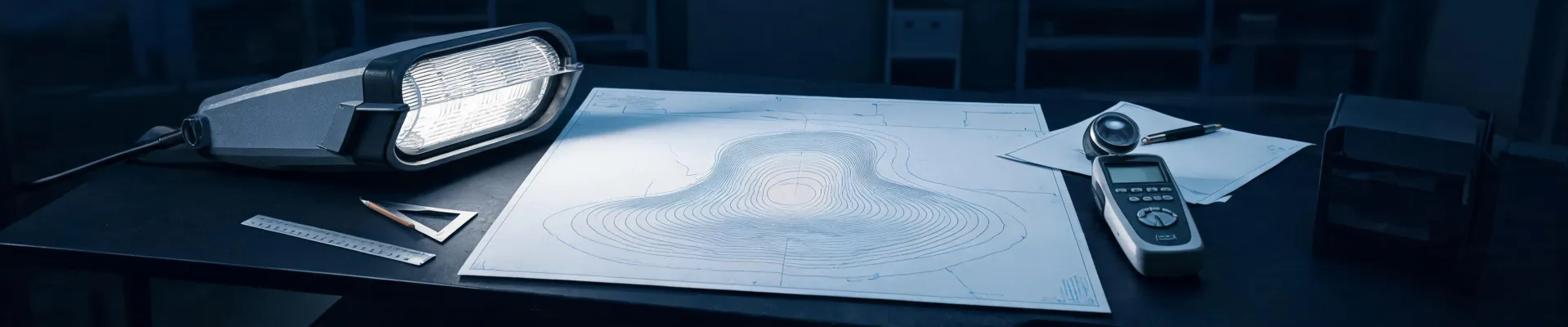
Too many street lighting wholesale cost guides start with a lumen-per-watt chart and a list of IP ratings. I almost wrote one like that in January 2025. Then I spent six weeks comparing manufacturer quotes for a 300-unit flood light order, and I scrapped the chart.
The trigger was a flood light private label request from a regional electrical contractor. They wanted 300 sports floodlights for two high school athletic complexes, with our distributor's brand on the housing and a delivery window that was already locked. We needed a manufacturer that could build a reliable fixture, manage the private label details, and support photometric layouts without turning every email into a week-long delay.
I manage procurement for a mid-sized lighting distributor. I don't design optics, and I don't pretend to be a photometric engineer. My job is to make sure the orders we take do not get eaten by hidden costs three months later. So when our existing floodlight supplier came in with a lower unit price and Schreder outdoor lighting came in with a higher one, I did not get excited. I got suspicious.
But the part that makes or breaks a lighting purchase is often missing from street lighting wholesale cost guides. The invoice line is maybe only sixty percent of the actual cost. The rest hides in engineering revisions, missing paperwork, freight damage, and after-sale support.
How The Flood Light Private Label RFQ Started
We already had a supplier for our seasonal flood light private label work. Their fixtures were acceptable. Delivery was mostly on time. But their documentation process was painful. Every submittal required two or three rounds of back-and-forth to get IES files that matched the exact fixture options in the quote. Their warranty claims had to be reviewed one by one, which added weeks to replacement orders. They were not a bad company. They were just optimized for the unit-priced sale, not for a distributor who wanted a repeatable private label program.
When I sent out the RFQ, I asked every candidate seven questions beyond the price list:
- Will you provide LM-80 and LM-79 reports with each quote?
- Can you supply IES files in the format we use for our lighting design software?
- Who answers technical questions after the sale?
- Can you support private label without charging a special setup fee on every small order?
- What happens when a fixture fails on site and who pays the return freight?
- Do you provide DLC and UL documentation that matches the exact configuration shipped?
- What are you not good at, and who do you recommend when that matters?
That last question produced the most honest replies. One vendor offered to be a one-stop shop for everything outdoor, plus indoor, plus controls. Another simply said they were not the right partner if we needed integrated control systems, and named two companies that were better. That answer made me pay attention.
The point is not that one-stop suppliers are always a lie. The point is that when you are building a predictable private label line, a supplier that understands its limits is easier to trust than one that promises the whole catalog.
The Schreder Lighting Quote Arrived Differently
Schreder lighting was on the RFQ list because two municipal street lighting specifications in our region had mentioned it. To be honest, in the first round I did not expect them to be competitive on a flood light private label project.
The initial Schreder lighting quote was roughly nine percent higher per fixture than our existing supplier. At 300 fixtures, that was about $7,800 of difference. I put that number at the top of my spreadsheet and almost moved on. But Schreder also sent a full technical folder with the first email. It included the photometric file for the exact fixture configuration, the driver sheets, surge protection options, IP rating data, and the compliance documents. No follow-up request. No second-round call to remind them that we cannot submit a lighting package without photometric files.
That contrast pushed me to build a total cost model. I am not a photometric engineer, so I cannot tell you whether Schreder optics are statistically better in a lab. What I can tell you from a procurement perspective is this: Schreder treated design support as part of the product, not as an extra service we had to fight for.
For a distributor, that kind of support has a direct dollar value. Every hour our own team spends chasing missing paperwork is an hour we are not spending on new bids. In the previous two years, our post-order budget overruns came more from chasing documents and rework than from fixture defects.
The Street Lighting Wholesale Cost Guide Number That Actually Matters
I built a comparison that separated price from cost. The existing supplier quote was lower on the unit line, but it did not stay lower once I added processing time.
The existing product quote for 300 fixtures was $85,800, plus $2,250 freight. Their design support allowed one free round of photometric adjustments, then billed site-specific modifications at $95 per hour. I allocated $4,200 for that line because sports lighting layouts in our experience almost always come with last-minute aiming changes. I also allocated $6,800 of internal labor to chase and re-issue compliance documentation, which was low based on our history. Add $2,100 for freight damage and replacement coordination. The total landed near $101,150.
Schreder's product quote was $93,600, and freight was $1,800. Their technical package included the photometric documentation with no extra billing for reasonable revisions during the bid phase. I allocated $1,500 for internal review and almost nothing for back-and-forth document chasing. The total was around $96,900.
So the higher unit price vendor was about four percent cheaper in total cost. That does not make Schreder cheap. It makes them less likely to create hidden costs.
Before I signed the pilot, I hesitated for a week. I went back and forth between the existing supplier and Schreder. The existing supplier knew our packaging quirks and had never missed a large ship date. Schreder had stronger documentation, a broader outdoor lighting catalog, and a team that was willing to say when a project required a different product.
The risk of switching was that a new manufacturer might stumble on something we had not anticipated. The risk of staying was that we would keep paying the same hidden costs and calling them normal. In the end, we did not sign a huge contract. We ordered 40 fixtures as a first pilot, then 85 for a smaller soccer facility, and only after those went smoothly did we commit to the full 175-fixture order.
Lessons After A Year Of Schreder Outdoor Lighting
Since the first pilot arrived in April 2025, we have shipped about 300 Schreder-based private label flood lights and a few area lights for municipal trials. I do not have hard data on how Schreder fixtures will perform after ten years. I only have the last twelve months of field reports. Based on those, the pilot went well enough that Schreder is now one of our approved suppliers for outdoor projects.
First, compare systems, not prices. If a supplier's quote process creates extra work, that work is part of the system and should be priced into the decision.
Second, ask suppliers what they won't do. The Schreder team did not claim to be a full indoor lighting source, and they did not push us toward complicated controls when the first project only needed static dimming. That honesty was worth more than a small discount would have been.
Third, run a pilot before making a big commitment. We avoided a classic procurement mistake: betting the whole year on a spreadsheet model, even one I trusted.
Fourth, update your RFQ checklist. We still start with IP rating and lm/W, but the deciding columns on our scorecard now say Documentation Completeness, Design Support, and Post-Sale Behavior.
If you are evaluating a flood light private label partner or a sports lighting supplier for the first time, build the same model. Not because Schreder will be the right answer for every application, but because the exercise will show you which suppliers are actually absorbing cost and which ones are quietly transferring it to your team.
I am not a lighting engineer, and I don't have a lab in my garage. What I do have is the spreadsheet from this 300-unit comparison. It still reminds me that the street lighting wholesale cost guide everyone quotes is usually missing the largest category of cost.
Clara Whitmore is a lighting photometry and LED source analyst specializing in bulbs, tubes, strips, panels, and integrated luminaires. She interprets IES LM-79 measurements and TM-30 color rendition data through luminous flux, efficacy, intensity distribution, CCT, chromaticity, fidelity, and gamut metrics. She writes evidence-led comparisons for specifiers selecting source formats and luminaires for commercial interiors, industrial spaces, or horticultural systems where measured optical and color performance matter.