-
Check #1: Request Photometric Files, Not Just a Datasheet
-
Check #2: Verify Compliance Paperwork Against Your Project
-
Check #3: Compare Total Delivered Cost, Not Unit Price
-
Check #4: Order a Physical Sample Before the Bulk Order
-
Check #5: Map the Warranty Process (Before You Need It)
-
Check #6: Ask What They Would NOT Sell You
-
Mistakes I Keep Seeing (and Have Made Myself)
-
The 10-Minute Recap
If you handle purchasing for a commercial property portfolio, a municipal account, or a distributor that carries outdoor lighting lines, you've probably been here: three quotes, three prices, no clear way to tell which one is actually the best deal. I've been managing procurement for our facilities since 2021—roughly 60 to 80 orders a year across eight vendors—and outdoor lighting was the category that cost me the most when I first started.
This is a practical checklist for buying Schreder outdoor lighting wholesale. I'm an office administrator, not a lighting engineer, so nothing here requires a technical degree. Six checks, in order. The first five will prevent the standard mistakes. The sixth one is the question most buyers never think to ask (especially me, at first).
Think of it as a wall light specification guide, too—several of my examples come from wall mount projects, because that's where I got burned the most.
Check #1: Request Photometric Files, Not Just a Datasheet
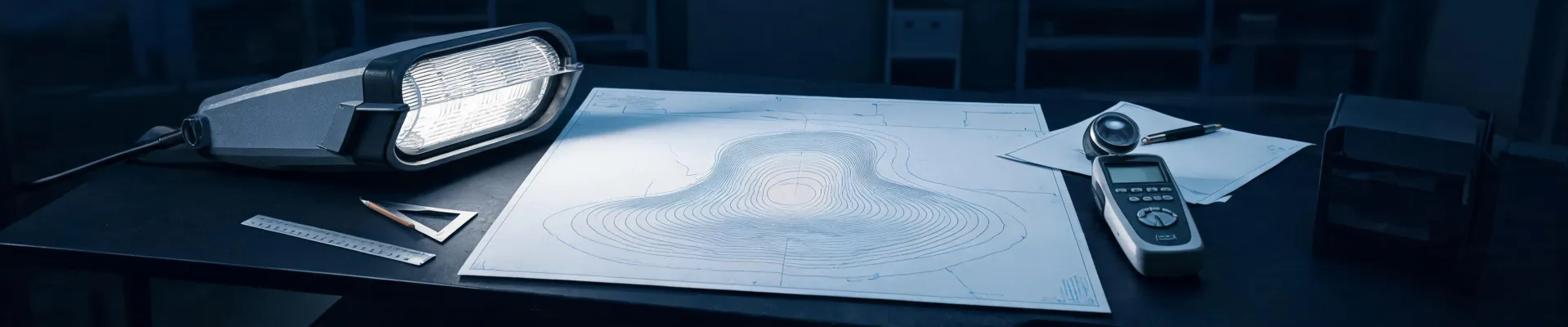
It's tempting to think that two flood lights with similar lumen numbers are basically the same product. They're not. Lumen output tells you how much light comes out. Photometric files—IES or LDT format—tell you where that light actually goes. That difference determines how many fixtures you need to hit your target illuminance and where shadows and hot spots land.
When a flood light distributor sends a quote for Schreder outdoor lighting, ask for the IES file for the exact SKU. Not "a similar one." Then do two quick checks:
- Does the beam distribution suit your application? A wall light designed for asymmetric wall washing is different from a wall light that spreads a wide, even wash over an open area. Both may sit in the same catalog category. They are not interchangeable.
- Is the file version current? Manufacturers update photometric data when optics change. If the file doesn't match the product version on the quote, the performance data is stale. Which, honestly, is exactly how I caught one distributor quoting a previous-generation optic.
A distributor who can't produce photometric files probably doesn't work with the brand closely enough to service your account properly. Move on.
Check #2: Verify Compliance Paperwork Against Your Project
This one seems straightforward, but the details are where quotes fall apart. A fixture can be perfectly fine for one project and completely non-compliant for another. The certification requirements depend on your destination market, so never let a distributor gloss over this.
For Schreder outdoor lighting projects in North America, the documents to request:
- UL/cUL listing: Not optional for most buyers. Ask for the specific listing number and confirm it covers the exact model on the quote, not just the product family.
- DLC listing: If your client wants utility rebates, the exact SKU must appear on the DesignLights Consortium qualified list. I've seen projects lose thousands in rebates because the family was listed but the specific wattage wasn't.
- Dark-sky / BUG rating: Increasingly required near residential zones. For wall packs specifically, backlight control is critical. A wall light with a high BUG rating creates light trespass and complaints no matter how good the fixture looks.
- IP rating: IP66 is the safe baseline for outdoor use. Anything less needs a project-specific justification.
I learned this one the hard way. I assumed "DLC listed" on a quote meant every variant of the product. Didn't verify. Turned out the 40-watt wall packs had a different listing status than the 80-watt flood lights on the same order. We lost a rebate window and ate a two-month delay.
Check #3: Compare Total Delivered Cost, Not Unit Price
Unit price is maybe 60 percent of what an outdoor lighting wholesale order actually costs you. The rest is freight, minimum order impact, installation labor, energy use over the rated life, and the time cost of resolving problems. This is the lesson that's cost me the most, so I'll keep it blunt: a low quote with a long lead time is not a low quote.
Example: the $500 flood light that arrives in twelve weeks is not a $500 flood light. Add $200 in freight—and your installation crew sitting idle waiting on backordered parts. The $650 fixture from a distributor with local stock and a three-day lead time can be the cheaper option by the time it's installed and running.
The formula I now use for every quote:
Unit price + freight + minimum order impact + energy cost over rated life + installation labor + potential warranty claim admin time.
When I ran this on our 2024 order pool, the lowest-priced quote was 18 percent more expensive than the mid-price one once all factors were included. Thirty minutes of math, roughly $4,600 saved.
Check #4: Order a Physical Sample Before the Bulk Order
You would be surprised how many purchasing managers skip this step with a "trusted brand." I was one of them. I approved a quantity of wall lights based on a sample that looked great—then the production batch arrived with a housing that was noticeably thinner. It photographed fine. It was only obvious when you held one. The manufacturer made it right, but the replacement cycle cost us a week of project time.
Order one sample from your shortlisted vendors and put it through three quick tests:
- Weigh it. Material changes reveal themselves in weight before anything else.
- Run it for 48 hours. Check for flicker, noise, or excessive heat. Your phone camera in slow-motion mode catches flicker your eyes won't.
- Compare physical specs to the datasheet. Dimensions, driver brand, wattage labels. If the sample doesn't match the printed spec, the production batch won't either.
A sample costs a bit of money. It's cheap insurance compared to discovering a quality mismatch after installing 200 units.
Check #5: Map the Warranty Process (Before You Need It)
Every Schreder lighting quote I've seen includes a warranty statement—five or ten years, depending on the product and component. The paperwork never tells you what the claims process actually feels like.
Before you commit, ask:
- Who handles defects? The distributor or the manufacturer? A good wholesale partner manages claims on your behalf. A weaker one hands you a phone number and disappears.
- Advance replacement, or send-and-wait? If a fixture has to go back before you receive a replacement, add the labor and downtime to your total cost. I didn't, at first. Then I did. (ugh)
- What's the documentation requirement? Serial numbers, purchase order, photos. If you don't have a filing system for these, start one before the first PO. Note to self: this boring step is what saves your budget.
A five-year warranty with a one-call replacement process beats a ten-year warranty that costs you a week of administrative time to enforce.
Check #6: Ask What They Would NOT Sell You
Here's the check most buyers skip. Call your shortlisted distributor, describe a specific project—a parking lot, a building facade, a sports field—and ask what they'd steer you away from.
A flood light distributor who says "don't use floods here, you want an area light with a cutoff optic" is giving you real value. A salesperson who recommends the same fixture for every application is taking orders, not managing relationships.
This matters for Schreder outdoor lighting specifically, because the range is broad. Street lighting, flood lights, wall lights, sports lighting, area lights—some fixtures look similar and behave completely differently in optical distribution and glare control. A distributor who knows the differences is worth more than a 2 percent discount. The best vendors, more often than not, will talk you out of a larger order when it's the wrong product. That's how they earn your next 20 orders.
Mistakes I Keep Seeing (and Have Made Myself)
Run those six checks and you'll avoid most of the classic problems. Still, there are three recurring traps worth naming:
- Comparing quotes that don't contain the same scope. One distributor includes mounting brackets and photocells in the base price. Another lists them as add-ons. Until you normalize the scope, the comparison is fiction.
- Forgetting reorder lead time. A distributor who can ship a replacement pallet in two weeks is fundamentally more valuable than one who needs eight. Lead time becomes a cost only when you're out of stock and a project is waiting. The "local is always faster" thinking comes from an era before modern freight networks. Today, a well-organized remote distributor can beat a local one on both price and availability—but you have to verify, not assume.
- Trusting "same brand" to mean "same specification." The photometric check covers this at the top level, but it applies everywhere: driver versions, housing materials, optic generations. Always compare the physical and digital spec of what's actually shipping.
The 10-Minute Recap
You don't need a lighting engineering background to buy Schreder outdoor lighting wholesale. You need a disciplined process:
- Get the IES photometric files and verify the version.
- Check UL, DLC, BUG, and IP ratings against your project's requirements.
- Calculate total delivered cost with the same scope for every quote.
- Order a physical sample before bulk quantities.
- Map the warranty claims process end to end.
- Ask what they'd not sell you—and listen carefully.
These six checks take a few hours. The problems they prevent take weeks or months to fix. If you're starting a new procurement cycle, run through this list before the next purchase order. It took me a few expensive lessons to learn this sequence. Hopefully it saves you the tuition.

Clara Whitmore is a lighting photometry and LED source analyst specializing in bulbs, tubes, strips, panels, and integrated luminaires. She interprets IES LM-79 measurements and TM-30 color rendition data through luminous flux, efficacy, intensity distribution, CCT, chromaticity, fidelity, and gamut metrics. She writes evidence-led comparisons for specifiers selecting source formats and luminaires for commercial interiors, industrial spaces, or horticultural systems where measured optical and color performance matter.