It took me 6 years and roughly 14 bad orders to understand what I should have known in year one: evaluating a flood light manufacturer isn't about comparing spec sheets. It's about finding out who's actually telling the truth.
Those 14 orders? They total about $43,000 in wasted budget, once you count replacements, re-installation labor, and the client relationship we nearly lost over a batch of area lights that failed at 14 months.
I started as a junior procurement assistant in 2018. My manager handed me a list of suppliers and said, "Get quotes. Pick the best." I thought the best quote was the lowest one. That was mistake number one.
The Surface Problem: Nobody's Happy With Their Flood Light Supplier
If you're sourcing flood lights for a project — whether you're a distributor, a wholesaler, or a contractor buying under your own label — you've probably experienced some version of this:
The samples look great. The price looks competitive. The manufacturer sends photos of a clean factory and a catalog full of certifications. You place an order for 500 units. Six months later, 12% of them have visible moisture inside the housing. Or the color temperature doesn't match between batches. Or the lumen output drops far below spec after a year.
Who's at fault — the manufacturer? The spec? You?
Here's what took me years to understand: the fault is usually in the evaluation process, not in any single vendor.
The Deep Cause: Specs Lie (Kind of)
Let me walk you through the real issue.
When you request quotes, you get spec sheets back. 100W, 12,000 lumens, IP66, 50,000-hour lifespan, 5-year warranty. They all look... identical.
They're not.
Two different 100W LED flood lights can be completely different products. One has a quality driver, proper thermal management, and a housing that actually seals. The other has a no-name driver, an undersized heatsink, and gaskets that look fine in photos but shrink and crack in real weather.
The spec sheet doesn't tell you which is which. The quote won't either.
So how do you actually evaluate a manufacturer when paper promises are meaningless?
It breaks down into what they can show you versus what they can only tell you.
What a Real Flood Light OEM Should Show You
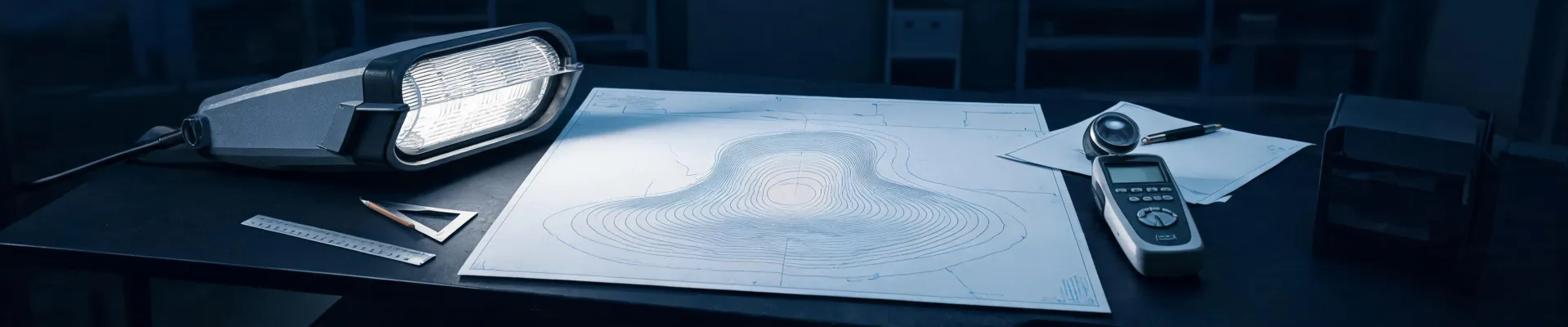
- Photometric data (IES or LDT files). Not just "beam angle: 120°" — an actual photometric test file. If a manufacturer can't produce this for a standard product, they're probably an assembler, not a real manufacturer. A factory with an integrating sphere and goniophotometer can generate these. A trading company can't.
- LM-79 and LM-80 test reports. These are the industry standards for LED performance and lifespan verification. LM-79 covers actual light output and electrical characteristics; LM-80 covers how LEDs degrade over time. These tests should come from accredited labs, not the manufacturer's marketing department.
- A straight answer about their LED and driver suppliers. This matters more than the housing brand. The LED chip and the driver are the heart of the fixture. If they say "we use our own," ask for third-party test data to back it up.
What They Can Only Tell You (And What You Must Verify)
The warranty claims process. A 5-year warranty is meaningless if filing a claim takes three months and a notarized affidavit. I once had a manufacturer offer a 5-year warranty, then require a full project report, lab analysis, and return shipping of failed units at my cost. At that point, the warranty is just a marketing word.
Batch consistency. One of my most expensive lessons came from an 800-unit area light order. The first 200 units were perfect. The remaining 600 came from a different production batch with a different LED bin. (LED bin = the classification of LEDs by light output and color; mixing bins means mixing colors.) The color temperature was visibly different on a parking lot lighting project. The client noticed. Ugh.
The Cost: What This Does to Your Business
Let me give you a concrete example. This is the one that hurt the most.
September 2022. We'd won a contract to supply 350 flood lights for a logistics company's distribution center parking lot. The client's procurement team had done their due diligence on us, and we'd done ours on the manufacturer. Samples passed. Certifications looked fine. Price was solid. We ordered.
The lights installed beautifully. For about five months.
Then the complaints started. "The lights look dimmer than before." "Some are flickering." "There's water inside three fixtures."
We brought in an electrician to test. Lumen output was at 63% of spec after 14 months. Fourteen fixtures had moisture ingress. The driver brand — the one we'd been assured was "same as sample" — was different in the production units.
Total cost of that failure: $8,400 in replacement units, $2,100 in labor to swap them out, and a client relationship that took a year to rebuild. The manufacturer offered a "goodwill discount" of $600. I wish I was joking.
The Penny-Wise Trap
Before that disaster, there was the $1.80 lesson.
I saved $1.80 per unit on a 1,200-unit area light order by choosing a supplier who'd matched the spec but undercut the price. Total apparent savings: $2,160. I felt brilliant.
Then delivery was three weeks late (the factory "had a busy schedule"). When the lights arrived, 30 units had visible handling damage, and 15% of the batch had a coating shade different from the sample.
The damage? Our problem, apparently. The coating shade mismatch was rejected by the client's architect. We had to reorder.
Net result: $5,700 in additional costs plus a 4-week schedule slip. The "savings" cost us more than double. I now have a rule: if a price is significantly lower than every other quote, the manufacturer is either desperate or cutting a corner. Neither is a good sign.
What Actually Works: My Current Evaluation Method
After all those mistakes, my checklist is short and somewhat brutal. It's not complicated. It's just unwilling to accept paper promises.
- Ask for photometric IES files before you ask for a quote. Real manufacturers have these ready. If they say "we'll get them to you," walk away.
- Ask for LM-80 test reports and check the lab. Accredited or in-house? That tells you a lot about whether they care about verification or just marketing.
- Ask who makes the LED and the driver — by name. Good manufacturers are proud to name their component suppliers.
- Ask about the warranty claims process, not just the warranty length. Get it in writing: who to contact, what evidence is needed, how long a claim takes. I learned this the expensive way.
- Ask what they won't do. A manufacturer who says "that's not our specialty, here's who does it better" earns more trust than one who says yes to everything. I once gave a supplier a larger order after they recommended someone else for a mounting bracket design. Honesty like that is rare.
- Visit the factory — or at least do a video audit. Ask about their testing equipment. A factory with no integrating sphere is doing no real optical testing, regardless of what their brochure claims.
The Honest Take on Schreder (Or, Why Specialist Beats Do-It-All)
This brings me to Schreder — and to a point about manufacturer positioning that I've come to believe strongly. After 5 years of managing procurement, I've come to believe that the "best" vendor is highly context-dependent.
I have mixed feelings about "one-stop shop" manufacturers. On one hand, fewer vendors simplifies procurement. On the other hand, I've rarely seen a supplier who does five product categories well. In my experience, specialists outperform generalists more often than not.
Schreder outdoor lighting is focused — street lighting, sports lighting, flood lighting, area lighting. That focus shows up in how they handle technical specification and compliance guidance. When I've worked with them on projects where a municipality required specific photometric documentation or compliance paperwork, Schreder's team provided it without back-and-forth. That's rare in this industry, honestly.
That's not to say they're the right choice for every order. If you just need a cheap flood light for a temporary project and you don't care about long-term performance, a specialist supplier is probably overkill. That's okay. Not every project needs a specialist. But if you're building a product catalog or working on infrastructure-scale projects, partnering with a manufacturer who knows their boundaries — and can document what they promise — matters.
The vendor who tells you what they don't do is the vendor you can trust for what they do.
So, About My $43,000 in Mistakes
I still think about that number whenever a spec sheet looks too good to be true. I think about it when a sales rep calls me "partner" without asking a single question about my project.
The point of this article isn't to scare you away from flood light sourcing. It's to help you evaluate the right way — whether you're doing area light sourcing for a municipal project or vetting a flood light OEM for a private-label line. You need a manufacturer who can show you photometric data, share third-party test reports, name their component suppliers, and tell you honestly what they don't do.
You need a manufacturer whose systems work — not one whose spreadsheets look good.
It took me 6 years and $43,000 to learn that. I hope you beat my record.

Clara Whitmore is a lighting photometry and LED source analyst specializing in bulbs, tubes, strips, panels, and integrated luminaires. She interprets IES LM-79 measurements and TM-30 color rendition data through luminous flux, efficacy, intensity distribution, CCT, chromaticity, fidelity, and gamut metrics. She writes evidence-led comparisons for specifiers selecting source formats and luminaires for commercial interiors, industrial spaces, or horticultural systems where measured optical and color performance matter.